
Explained
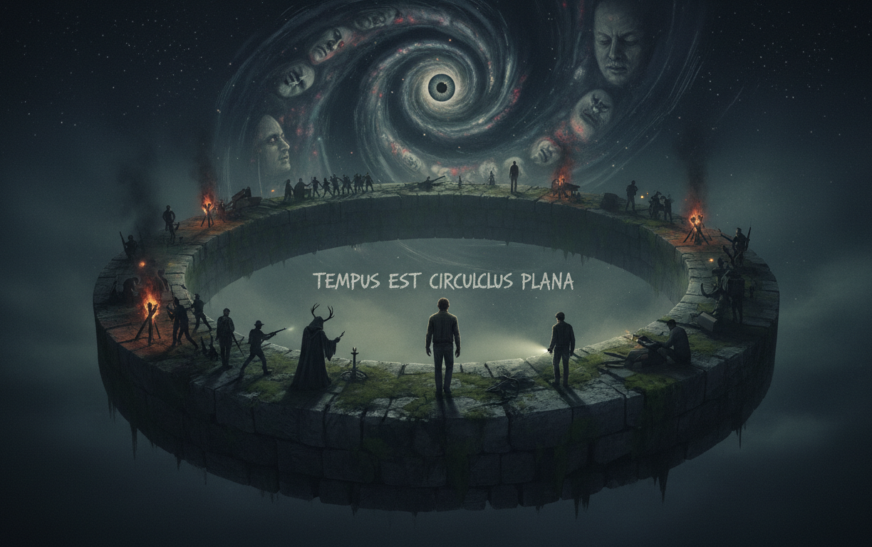
Time is a flat circle simply means that events don’t progress linearly—they loop, repeat, and echo across history and personal lives. In True Detective, especially in Season 1, this idea shapes the characters’ worldviews and drives the mood. Rust Cohle’s haunting assertion that time is a flat circle sums up the show’s recurring themes of fate, trauma, and human nature.
Philosophical Underpinnings: Nietzsche, Eternal Recurrence, and Cosmic Despair
Eternal Recurrence: Nietzsche’s Shadow
Friedrich Nietzsche’s concept of eternal recurrence suggests that all events in life repeat infinitely. Cohle’s line in Episode 5—“Time is a flat circle… all we’ve ever done or will do, we’re gonna do over and over again”—echoes this idea. It’s not just poetic. It showcases his depression and belief that nothing truly changes, no matter how hard people try.
Cosmic Indifference and Absurdity
Cohle isn’t only frustrated by personal suffering. He leans into a cosmic pessimism—the notion that the universe is fundamentally indifferent or even hostile to human values. This is in line with Camus’ absurdism, where meaning is human-made and often fleeting. Detecting killers won’t change the world; the crime has already happened, and it will happen again in another form.
Character Through Philosophy: How Ideas Shape the Detectives
Rust Cohle: Eternal Sisyphus in a Detective’s Coat
Cohle’s philosophical monologues aren’t just intellectual. They define how he lives and investigates. He speaks of becoming “a tragic figure,” someone caught in an endless struggle. His lifestyle—unconventional, recluse, brutal honesty—mirrors the idea that existence is a repeating, punishing cycle.
Marty Hart: The Illusion of Order
Marty represents the opposite: a desperate cling to norms, family, and control. But his facade cracks easily. Despite having a family and a job, he still fails. It illustrates that the illusion of progress is just that—an illusion. The philosophy at play makes his failures feel inevitable.
Storytelling in Loops: Repetition Beyond Dialogue
Rhythmic Patterns
Season 1 uses visual and narrative loops to reinforce the philosophy. The Louisiana landscape seems unchanged over decades. The same crimes, the same human failings—these repeat. Flashbacks and broken timelines swirl together, inviting viewers to feel the weight of recurrence.
Moral Echoes
Every character confronts their past decisions. The detectives repeat mistakes emotionally—Marty’s infidelity, Cohle’s alienation. Their arcs mirror one another, suggesting redemption is always out of reach, and history is stuck in place unless actively disrupted, which they fail to do.
Real-World Context: Why the Flat Circle Resonates Now
People increasingly feel stuck in personal and societal patterns. Climate anxiety, political turmoil, and social fragmentation give everyone déjà vu. Cohle’s line connects because many sense life’s loops more keenly than ever. It’s no wonder that True Detective found such a strong cultural echo.
Example in Pop Culture: Repetition as Narrative Tool
David Lynch’s Twin Peaks does something similar. Scenes repeat, phrases recur, characters dream the same moments. Viewers get a sense that events are preordained. True Detective doesn’t go as surreal, but its insistence on cycles taps into the same dramatic power: story as an echo chamber.
Expert Insight
“When fiction leans into recursive structure, it reflects not only trauma but also the human yearning to break free,” says Dr. Alex Morgan, philosophy professor and narrative studies expert.
That captures why True Detective feels so resonant. It isn’t just about crime. It’s about time, memory, and the inertia of human behavior.
Anatomy of Recurrence: How the Show Structures It
Interlaced Timelines
Switching between years shows how characters don’t grow in a straight line. Instead, they circle back to the same emotional space, like a record skipping grooves.
Symbols of Circular Time
- The spiral symbol recur throughout. It suggests cycles and return.
- The Venona theory, the occult clues—they point inward, not upward or forward.
Dialogue as Repetition
Cohle’s speeches don’t just repeat ideas; they amplify them. Each line drives the sense that time isn’t moving forward. And again, in another form, the same human truths come back.
Beyond True Detective: Philosophy Meets Noir
Detective noir often frames human nature as dark and immutable. True Detective ties that to a philosophy of recurrence. The result: a detective drama that feels more existential than forensic. It’s not “whodunit.” It’s “why do we keep becoming who we were?”
Contrast with Traditional Police Procedurals
Most crime dramas promise resolution—bad guys caught, order restored. Here, the crime ends, but the emotional wreckage lingers. Time’s flatness means the real crime is internal and persistent.
How It Affects the Viewer
You don’t watch True Detective to feel hopeful. You watch to feel tangled. The loops make you ask: am I stuck, too? Did I already make this choice? The show doesn’t answer. Instead, it deepens the unease.
Breaking the Circle: Is Redemption Possible?
The show leaves room, however small. Cohle’s eventual recognition of a flicker of beauty—his daughter, even his small acts—suggests the flat circle isn’t an apocalyptic doom. It’s a repeating structure that one can still nudge, if only slightly.
Conclusion
True Detective frames time not as a forward march but as an unyielding loop. Rust Cohle’s existential despair, Marty Hart’s fragile normalcy, and the show’s repetitive structure all drive home that nothing truly ends—it just circles back. Yet, in the cracks of those loops, the show hints at something more human: a chance, maybe small, to push against recurrence. That tension—hope in the face of eternal return—is what makes the show unforgettable.
FAQs
How does “time is a flat circle” tie into True Detective’s plot?
It underpins Rust Cohle’s worldview and animates the show’s non-linear storytelling. You see loops in time, behavior, and even landscape, showing that progress is often illusory.
Which philosophy does the line reference?
Primarily Nietzsche’s eternal recurrence and elements of Camus-style absurdism. It reflects a universe that’s indifferent and a life that repeats unless actively changed.
Is the show suggesting hope is impossible?
Not entirely. While the cycle is brutal, small moments—memory, love, choice—hint that people can, perhaps, break the circle, however gently.
What narrative techniques reinforce this idea?
The interwoven timelines, repeating symbols like spirals, and dialogue both thematic and visual all reinforce time’s circularity instead of linear progression.