
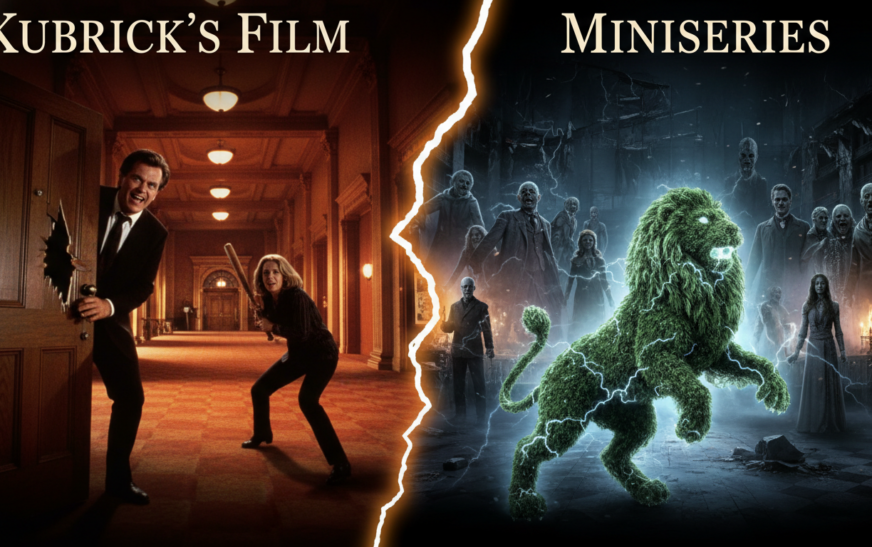
The 1997 miniseries The Shining, scripted and produced by Stephen King, is a more faithful adaptation of his novel than Stanley Kubrick’s 1980 film. It emphasizes gradual character decline, critical themes like alcoholism, and the novel’s original ending, whereas Kubrick’s version transforms the story into a more detached, ambiguity-rich cinematic experience. King’s version is emotionally grounded; Kubrick’s is iconic but colder.
Narrative Faithfulness and Character Depth
Kubrick’s film diverges sharply from the novel by turning Jack Torrance into a character who appears unhinged from the very start, rather than showing the slow descent King intended. King himself criticized that portrayal, noting Jack seemed “crazy from the first scene,” losing the tragic arc of a man undone by external and internal forces . On the other hand, Steven Weber’s portrayal in the miniseries reflects a man battling alcoholism, a crucial trait in the source material .
Wendy Torrance also receives an overhaul in the miniseries. In Kubrick’s version, she’s often seen as weak and passive—what King called a “screaming dishrag” . The miniseries, with Rebecca De Mornay in the role, presents a sturdier, more empathetic Wendy who resonates more with the novel’s version .
Plot Elements and Horror Imagery
Kubrick’s film adds visually chilling and now-iconic moments that are absent from the book: “Here’s Johnny!” and “All work and no play…” aren’t in King’s novel . The twins and the gushing elevator blood are similarly dramatic devices unique to the film .
By contrast, the miniseries restores many novel-specific details. The animated hedge animals, although hampered by aging effects, are included to honor King’s vision . Other subtle eerie moments, like a regenerating wasp’s nest, streamers in the elevator, and a living firehose, are woven in to mirror the book more closely .
Location, Tone, and Emotional Core
Kubrick filmed in studio recreations (based on the Timberline Lodge) and left much to interpretation; the Overlook feels alien and totally isolated . The miniseries, however, was shot on-site at The Stanley Hotel in Colorado—the very spot that inspired the novel—which gives it authenticity and a tangible connection to King’s original setting .
Tonally, Kubrick’s adaptation is cold, atmospheric, and visually striking but emotionally distant—King likened it to “a big, beautiful Cadillac with no engine” . The miniseries, while less visually polished, leans into emotional intimacy. King felt it added the warmth and narrative clarity he felt was missing .
Endings and Legacy
One of the starkest contrasts lies in the endings. Kubrick’s film concludes bleakly with the hotel frozen—and survival of the status quo . King’s novel—and the miniseries—end in fiery destruction, with the Overlook annihilated by its failing boiler . To King, the film’s icy finish replaced the emotional and symbolic “burning down” of the old with cool detachment.
Over time, Kubrick’s film has grown in acclaim and cultural ubiquity, influencing pop culture and spawning theories from conspiracy to psychoanalysis (as seen in documentary Room 237) . The miniseries, while praised initially for its pacing and emotional layers—winning Emmy and Saturn Awards—has since faded in esteem, often criticized as dated or overly literal .
“I feel as though I’d given Stanley Kubrick a live grenade, and he heroically threw his body on it.”
This quote from King sums it up: visually stunning, yes—but missing the emotional engine.
What Works (and What Doesn’t) in Each Version
Kubrick’s Film
- Iconic visuals, unforgettable cinematography and imagery.
- Ambiguous and interpretive, ideal for analysis and atmosphere.
- Lacks core emotional beats and character development from the novel.
King’s Miniseries
- Stays truer to novel’s pacing, character arcs, and themes like alcoholism.
- Includes specific supernatural elements and novelistic details.
- Effects and production quality reflect mid-90s TV and can feel dated.
Conclusion
The 1997 miniseries is where Stephen King finally got to tell The Shining his way—closer to the emotional truth and story structure of his novel. It’s tragic, personal, and more explanatory. Kubrick’s film, meanwhile, turned the story into an elegant, haunting visual poem—masterful but distant. Each version stands on its own: the miniseries anchored in authorial fidelity, the film soaring in cinematic legacy.
FAQs
What is the main narrative difference between the miniseries and Kubrick’s film?
The miniseries shows Jack’s slow descent into madness, rooted in alcoholism and love for his family. Kubrick presents Jack as unstable from the start.
Why did Stephen King dislike Kubrick’s version?
He found it emotionally cold and distant, seeing the characters as unrelatable and the story too abstract compared to his heartfelt novel.
Are scenes like the hedge animals included in both adaptations?
The film replaces hedge animals with a hedge maze for dramatic effect. The miniseries reinstates the hedge animals, though the effects are dated.
How do the endings differ?
Kubrick’s film ends with the hotel frozen and survivors escaping. The miniseries (and novel) conclude with the hotel exploding due to a faulty boiler—symbolizing destruction and finality.