
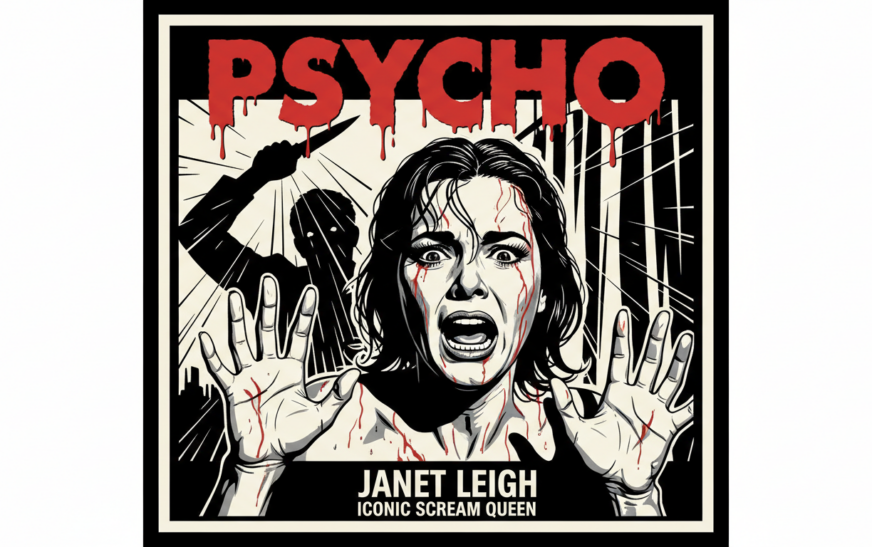
Janet Leigh’s legacy as the ultimate scream queen of Psycho is anchored in her unforgettable role as Marion Crane—the woman who meets a shocking fate in the now-iconic shower scene. That role made her a legend in horror cinema and left a mark so deep that it shaped her life, her career, and even the genre itself.
Early Life and Journey to Hollywood
Janet Leigh was born Jeanette Helen Morrison on July 6, 1927, in Merced, California, and raised in Stockton by parents facing economic hardship. Despite the struggle, she excelled in school, graduating high school at 16 and later attending the College of the Pacific, where she studied music and psychology. She supported her family through holiday jobs and work at the college’s info desk.
Her screen journey began when actress Norma Shearer discovered a family photo of Leigh at a ski resort. Enchanted, Shearer introduced Leigh to MGM, launching her into the Hollywood scene. Leigh’s debut at MGM led to varied roles in melodramas, westerns, comedies, and literary adaptations.
Rising Star and Hollywood Versatility
At MGM, Leigh quickly proved she wasn’t just a pretty face—she was a talent. She starred in films like Little Women, Scaramouche, and The Naked Spur, demonstrating range across comedy, drama, and romance.
By the mid-1950s, Leigh transitioned to Universal and Columbia. Her ventures included the noir Touch of Evil (1958), directed by Orson Welles, and the adventure Safari (1956). Her versatility underscored her adaptability in genres beyond glamour.
Breaking Conventions in Psycho
Casting and Role
In Alfred Hitchcock’s Psycho (1960), Leigh played Marion Crane, a secretary who steals money and finds refuge at the eerie Bates Motel. Hitchcock’s decision to kill off Leigh’s character so early shocked 1960s audiences—she was his leading star, yet she’s gone before the film’s end.
The Shower Scene’s Power
Leigh’s murder scene in the shower, lasting only about 45 seconds on screen, involved seven days of filming across twenty takes. Hitchcock used creative techniques—like chocolate syrup for blood and melon-stabbing for sound—to create a shockingly visceral effect while preserving black-and-white aesthetics.
That moment became cinema’s most renowned horror moment, blending tight editing, Bernard Herrmann’s shrieking score, and Leigh’s raw vulnerability into a chilling masterpiece.
Leigh later reflected on the film’s lingering impact: “I’ve been in many films. But if an actor is remembered for one role, they’re lucky. In that way, I’m fortunate.”
A Price Paid—Psychological Ripple Effects
The aftermath haunted Leigh. She revealed she avoided showers for years, opting for baths instead; if forced to shower, she’d leave curtains open, lock doors and windows, and always face the bathroom door.
On top of that, she endured disturbing fan reactions that reportedly involved threatening letters—so unsettling the FBI became involved. The role she played for art left her with real, real trauma.
Legacy—From Screen to Influence
Awards and Recognition
Leigh’s performance won her a Golden Globe for Best Supporting Actress and earned an Academy Award nomination—the early-highpoint recognition of a career-defining role.
Influence on Horror and Cinema
As a false protagonist, Marion Crane challenged storytelling norms—especially in horror. Psycho redefined audience expectations, paving the way for slasher films and deeper character unpredictability.
Cultural Endurance
Year after year, the film and the shower scene remain cultural touchstones. Psycho is preserved in the U.S. National Film Registry for its significance and ranks among the greatest films ever made according to critics and organizations like Variety.
Julia Leigh’s aesthetic and dramatic impact has also had unexpected cultural ripples—from modern fashion referencing her sleek secretary style to filmmakers continuing to emulate that suspense blueprint.
Horror Bloodline
Janet Leigh’s scream queen legacy didn’t end with her. Her daughter, Jamie Lee Curtis, would become horror royalty in her own right, starring in Halloween (1978) and even recreating the iconic shower scene in Scream Queens.
Lasting Honors
Her hometown honored her with a plaza memorial plaque. The University of the Pacific dedicated a theater in her name, and a ski trail was named for her at Sun Valley Resort—ever reflecting her lasting footprint.
Conclusion
Janet Leigh’s portrayal of Marion Crane made her the scream queen for the ages. She brought depth and vulnerability to horror, reshaping both audience expectations and cinematic standards. Her legacy lives not just in film archives, but in how fear, vulnerability, and surprise continue to be written into horror. Beyond that, her influence echoes in culture, fashion, family, and the heart of suspense storytelling.
FAQs
Was Janet Leigh truly the first scream queen?
She wasn’t the very first, but her role in Psycho popularized the term. Her performance defined what being a scream queen meant—being at the center of cinematic horror.
Did she really stop showering after Psycho?
Yes. Leigh revealed she avoided showers for years, only taking baths. When she did shower, she took precautions like locking doors and keeping the curtain open.
How did Psycho change horror forever?
Its narrative twist—killing a lead character mid-film—shattered genre norms. It also introduced psychological suspense, behind-the-scenes realism, and the blueprint for slasher films.
What accolades did Leigh earn for her role?
Her role won her a Golden Globe for Best Supporting Actress and an Academy Award nomination, solidifying the performance as award-worthy almost instantly.
Did her legacy continue through her family?
Absolutely. Her daughter, Jamie Lee Curtis, became a horror icon herself in Halloween, and paid tribute by recreating that shower moment decades later.
What honors did she receive posthumously?
She has a memorial plaza, a theater named in her honor at her college, and even a ski trail named after her—lasting reminders of her impact on film and culture.