
Ichabod Crane: The Lone Schoolmaster Who Meets a Headless Horseman
Ichabod Crane is the main character in Washington Irving’s 1820 short story The Legend of Sleepy Hollow. He’s a tall, lanky schoolteacher who courts Katrina Van Tassel but vanishes one eerie night after encountering the Headless Horseman—a spectral Hessian trooper. Some believe he fled in fear; others suspect a trick by rival Brom Bones.
Origins: Where Did Ichabod Come From?
Real‑World Inspirations
Irving’s Ichabod leaps off the page but is loosely based on real people. One key influence was Jesse Merwin, a schoolmaster from Kinderhook, New York, who Irving knew and corresponded with for decades. Martin Van Buren even referred to Merwin as the “pattern” for Ichabod.
There’s also mention of Colonel Ichabod B. Crane, a real US Army officer Irving may have met around 1814. Though sharing the name, there’s no concrete proof Irving based his character on the colonel.
And another layer: “Lockie Longlegs,” a lanky Scottish teacher Irving wrote about, may have influenced the physical description.
Together, Ichabod emerges as a blend of Merwin’s personality, a real man’s name, and a long-legged teacher’s comedic image. Odd mix, right? But that’s what makes him memorable.
Name That Speaks Volumes
Ichabod means “without glory” in Hebrew. Paired with “Crane,” it suggests awkwardness and ungainliness—both perfect for a lanky, superstitious schoolmaster.
Character Snapshot: Who Is This Ichabod Guy?
Odd Schoolmaster with Grand Ambitions
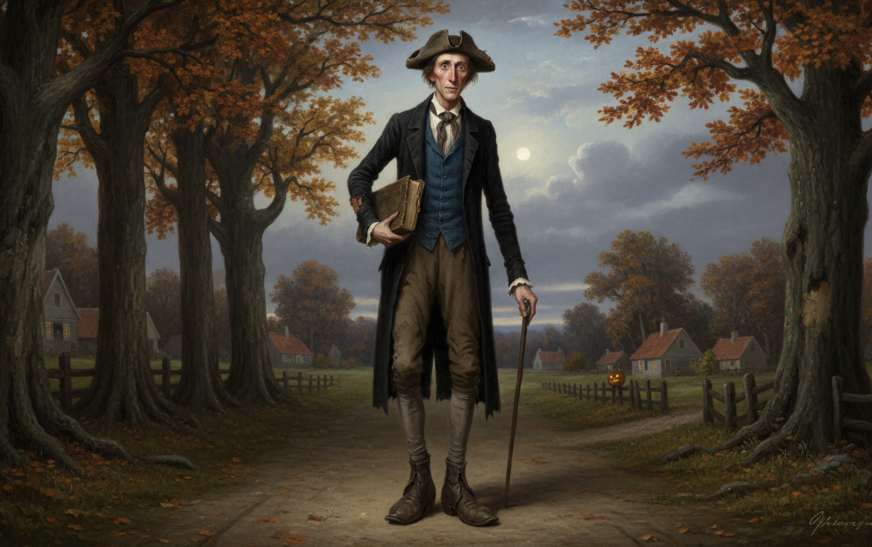
Crane is portrayed as physically awkward—long arms, narrow shoulders, huge ears—like a scarecrow escaped from a field.
He’s poor, really scraping by. His community boards him during the week in exchange for chores like haying or mending fences. He’s also the singing-master, teaching psalm singing for extra pennies.
Brainy—but Gullible
Ichabod loves to read, especially books on witchcraft and folklore, like Cotton Mather’s witch-hunting tales. He devours ghost stories and scares himself silly, adding credibility to his superstitious nature.
Flawed, Funny, Ambitious
He wants to better himself by marrying Katrina Van Tassel, a rich farmer’s daughter. But he’s not exactly endearing. He imagines himself charming and refined, though others view him as clumsy and foolish.
That Fateful Night: The Encounter That Changes Everything
The Harvest Party
One autumn evening Ichabod attends a harvest party at Katrina’s home. He tries to win her over, using his singing and erudition as tools. But Brom Bones—a local jock and prankster—gives Ichabod déjà vu of ridicule and rivalry.
The Chase Through Sleepy Hollow
On his ride home at night, Ichabod’s nerves fray as he hears legends of a spectral Hessian headless horseman. Then the ghost appears, riding after him. Ichabod freaks out, rides like mad toward the bridge—the one place the ghost can’t cross… or so he hopes.
At the bridge, the Horseman hurls something that seems like a head. Ichabod is knocked off his horse. Next day, all that’s found is his hat and a smashed pumpkin. Ichabod is gone.
What Really Happened?
Some villagers think the Horseman was real. Others say Brom Bones played a prank—he even laughs heartily at the mention of Ichabod’s disappearance. Over time, some hear that Ichabod fled, humiliated, and started a new life elsewhere.
Why Ichabod Still Haunts Us
A First‑Rate American Tale
Irving’s story was among the first widely read American short stories. Together with Rip Van Winkle, it helped establish short fiction in U.S. literature.
A Cultural Ghost Story
Set in real places like Sleepy Hollow and the Old Dutch Church, the story blends fact and folklore deftly. Irving drew on real family names, local legends, and Revolutionary War history.
Halloween’s Star
Every October, The Legend of Sleepy Hollow resurfaces in media, tours, films—its spooky vibe perfect for Halloween.
The Perfect Unreliable Narrative
Ichabod is both credible and ridiculous. His exaggerated fears and own boastful nature might make the story part ghost-tale, part comedy, part early American satire.
“He’s not a ghost story villain as much as a mirror—showing us how belief and ambition can collide in unexpected ways.”
Legacy Beyond the Page
Schoolhouse That Stands
The original schoolhouse where Merwin taught is now called the Ichabod Crane Schoolhouse. It’s preserved as a historical site in Kinderhook.
Art Inspires Art
Felix O. C. Darley’s illustrations from the mid‑1800s helped shape how people visualize Ichabod—scrawny, nervous, whimsical. His prints were featured in editions and remain iconic.
Countless Adaptations
From classic TV movies to Tim Burton’s 1999 film starring Johnny Depp, and the modern supernatural drama Sleepy Hollow, Ichabod continues to morph in pop culture.
Conclusion
Ichabod Crane is that unforgettable figure: an awkward schoolmaster with big dreams and bigger fears. His story blends comedy with cautionary undertones—about pride, superstition, and competition—and cements America’s early taste for ghostly tales. His legacy lives in art, literature, festivals, and Halloween lore, reminding us that the scariest things often happen in the dark, and maybe in our own minds.
FAQs
What does Ichabod Crane symbolize?
He represents the overreaching Yankee—educated but full of pretension and superstition, hungry for social status yet vulnerable to ridicule and fear.
Did Washington Irving base Ichabod Crane on a real person?
Partly. The character drew from Jesse Merwin, a schoolmaster friend, plus a real army officer and a lanky Scottish teacher—mixing fact and fiction.
Why did Ichabod disappear?
It’s ambiguous. Some suggest the Headless Horseman got him; others think he was frightened away by Brom Bones or embarrassment and ended up starting a new life elsewhere.
Why is The Legend of Sleepy Hollow so enduring?
Because it’s rich in atmosphere, blends history with folklore, offers ambiguous mystery, and has become a Halloween classic embedded in American culture.
Where is the original schoolhouse?
It’s in Kinderhook, New York. Named the Ichabod Crane Schoolhouse, because Irving’s inspiration taught there.