
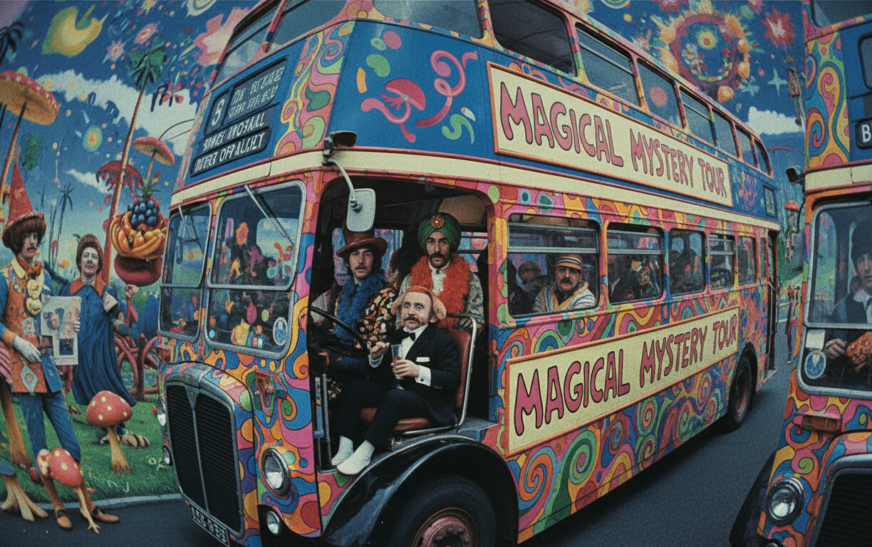
The Beatles’ Magical Mystery Tour is a 1967 British made-for-television short film driven by spontaneous absurdity. Directed, written by, and starring the Beatles, it captures a surreal, freewheeling coach trip filled with improvised scenes, musical set pieces, and dreamlike imagery. While critics initially panned it, the film’s psychedelic visuals and musical interludes—most of which were creatively improvised—have earned it a cult status among fans and scholars alike .
A Free-Roaming Experiment in 1960s Psychedelia
Paul McCartney conceived Magical Mystery Tour as a psychedelic road trip inspired by Ken Kesey’s Merry Pranksters and England’s coach trip culture . Filming kicked off with little more than a “circle on a blank sheet of paper” to map out the journey, and the script evolved spontaneously during production . The result is deliberate chaos—a spectrum of musical fantasy, nonsensical sketches, and hallucinatory imagery.
Unscripted Scenes Meet Musical Fantasia
The narrative is more collage than story: guests board a coach for an unspecified mystery trip. Ringo Starr and Aunt Jessie argue. Magical misadventures unfold via musicians disguised as magicians. Surreal set pieces feature a spaghetti-shoveling John Lennon, a striptease by Jan Carson, a hazy bus race, and a grand ballroom finale to “Your Mother Should Know” . The film is punctuated by standout performances of “I Am the Walrus,” “Blue Jay Way,” and “The Fool on the Hill” .
Behind-the-Scenes: Disorder on Set, Order in Song
The Beatles embraced creative disarray. Filming took place at a decommissioned RAF base—the coach’s spontaneity even sparked real traffic jams as locals followed the psychedelic journey in real time . George Martin, usually the steadying force in the studio, called the sessions “disorganised chaos” and took a step back, leaving engineer Ken Scott in charge . Yet out of this creative swirl emerged songs like “I Am the Walrus,” which Lennon aimed to sound “beamed in from outer space” .
Reception Then and Now: From Boxed Preview to Cult Appreciation
Upon its BBC debut on Boxing Day 1967, the film flopped with critics. Audiences found it incoherent, vague, even indulgent . But the soundtrack was a smash. In the UK, the double-EP charted highly—while in the US, expanded into an LP, it topped Billboard’s album chart for weeks and earned a Grammy nomination .
In later years, opinions shifted. Many rediscovered it as a daring, avant-garde ride. Some modern viewers liken its tone to early Adult Swim or Monty Python’s surreal comedy . Others still find the film’s charm hiding behind its absurdity and jagged pacing .
“The project was called ‘open‑ended’—and it showed. But that’s where the magic lies.”
—Music historian on Magical Mystery Tour
Key Elements of Its Surreal Language
1. Improvised vignettes as a mirror to 1960s chaos
Each scene emerges with minimal planning—spaghetti served as whimsy, magicians appearing unannounced, fans chasing the bus in real time. It’s cinema as happening .
2. Psychedelic visuals marry to studio experimentation
In the “Blue Jay Way” sequence, prismatic cameras mimic a fly’s-eye view. Harrison appears smog-shrouded—visually disoriented—and perfectly aligned with the song’s mood .
3. Music that outstrips the medium
Though the movie was hit or miss, its soundtrack defined psychedelic pop. The Beatles, freed from typical format rules, created scenes in sound that became more enduring than the plot .
Why It Still Matters Today
Magical Mystery Tour isn’t slick. It’s rough, playful, confused—but that makes it precious. It’s a raw snapshot of The Beatles exploring film without rules. It’s a portrait of 1967 counterculture, showing that art can be more about process than polish.
It influenced later comedy-surrealism. Reddit fans say you can trace lines from this chaotic mini-film to Monty Python and visionary offbeat programs of later decades . In a way, it helped sketch the comedy-satirical future.
Conclusion
Magical Mystery Tour is, at once, scattershot and unforgettable. Its lack of structure is its point. It’s a psychedelic sketchbook in motion—loose, spontaneous, jarring, and musical. The film flopped then. Now it’s a piece of cult and counterculture lore. More importantly, it reminds us who the Beatles were at their most playful—bold enough to make a movie about nothing, and still, make magic.
FAQs
What is Magical Mystery Tour about, exactly?
It follows the Beatles leading a mystery coach trip filled with bizarre and improvised scenes—from a spaghetti-shoveling waiter to magicians—and musical interludes. There’s no conventional plot; it thrives on surprise and psychedelic humor.
Did The Beatles write the script?
Not really. There was no firm script. Paul McCartney sketched a rough route on paper and the rest was improvised. Scenes evolved on the fly during filming.
How was the film received on release?
It got mixed to negative reviews at first, many blamed its randomness and lack of coherence. However, the soundtrack was widely acclaimed and commercially successful.
Has the film aged well?
For many viewers, yes. Its offbeat, surreal quality is now seen as a creative boldness—it’s recognized as a precursor to later surrealist comedy and experimental film.
What songs feature in the film?
Key tracks include “I Am the Walrus,” “The Fool on the Hill,” “Blue Jay Way,” “Your Mother Should Know,” and the instrumental “Flying,” among others.
Is it worth watching today?
Absolutely—if you’re open to oddball, music-driven art. It’s not a traditional film, but its charm lies in its spontaneity, psychedelia, and Beatles history.