
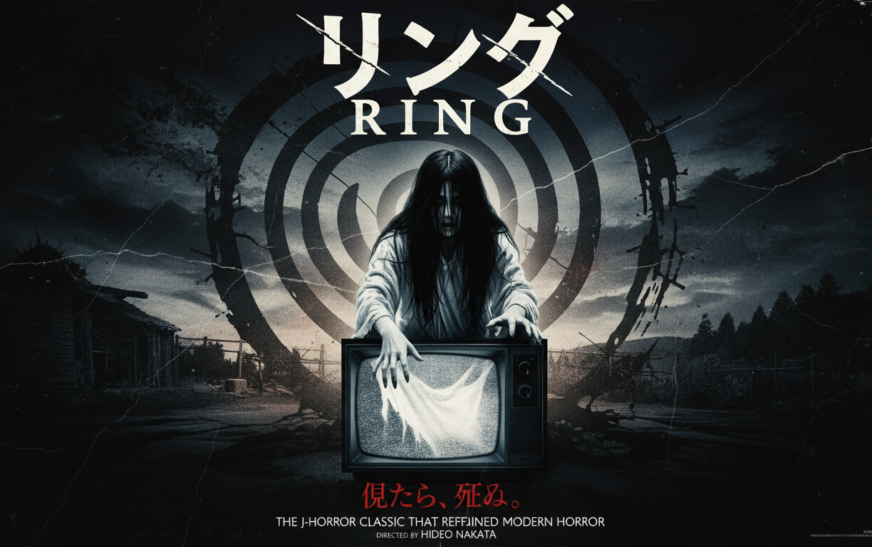
Ring delivers a promise in its title: the film still scares us today. This Japanese horror milestone, released in 1998 and directed by Hideo Nakata, is known for its chilling urban legend—a cursed videotape that kills anyone who watches it in seven days. The film reshaped horror by blending subtle dread, haunting visuals, and deep psychological fear in a way mainstream horror had largely ignored.
Origins and Cultural Roots
Ring isn’t just a scary movie; it’s deeply rooted in Japanese folklore and media culture. It started from Koji Suzuki’s novel Ring, inspired in part by older stories of vengeful spirits and media curses. In Japan, ghost stories—called kaidan—are woven into the cultural fabric. Ring modernized the idea of a ghostly curse by placing it in a VHS tape, a tech twist that Terrifyingly felt plausible.
To folks in the 90s, videotapes were everyday objects. Imagine spotting a random tape lying around, and curiosity wins. That familiarity made the horror feel closer to your living room. Beyond that, Ring played with the idea of how urban legends spread like wildfire, long before social media amplified every rumor.
Visual Language and Subtle Tension
The film was groundbreaking in how it built suspense. It leaned on atmosphere, slow buildup, and foreboding visuals instead of big jumps or gore. Think dripping taps, flickering TV screens in dark rooms—that sense of something being off without yet knowing what.
Cinematographer Junichirô Hayashi framed scenes with tight compositions and shadowy lighting. The images felt claustrophobic. The camerawork rarely lingered, yet each frame stuck with you. This visual restraint inspired many horror filmmakers—both in Japan and globally—to prioritize mood over shock value.
John Carpenter, a horror legend, once noted that Ring “redefined how fear can be conveyed in silence instead of explosions.” That observation echoes perfectly: when horror whispers, you lean in closer—and then it yanks you into dread.
Psychological Horror Over Physical Shock
Ring fixed our expectations. Instead of spiders, slashers, or sheer blood, the fear was existential. You weren’t being stalked by a visible monster—your own anticipation became the monster. Is something moving in the corner? Why’s the TV flickering? That unease stretches before the star drops.
Beyond the tape’s curse, the characters wrestle with helplessness. Watching the tape means knowing you’re doomed, but how can you fight something you barely understand? That internal struggle is far more unsettling than overt threats.
A scholar of horror film, Prof. Aya Matsumoto, summed it up well:
“Ring invites the viewer into a quiet dread, where the most terrifying elements are suggestions. It’s fear amplified by your own mind.”
Global Impact and Legacy
The film launched a wave of J‑Horror craze in the early 2000s. Mad studios across the world saw if you handled horror subtly and smartly, people would still be spooked—not by loud noises, but by lingering dread. The American remake in 2002 proved it: Ring’s core idea worked across cultures. It sparked a trend where horror films trade gore for goosebumps, from Ju‑on and Dark Water to newer waves of prestige horror.
Even today, many indie filmmakers study its structure:
- Everyday setting turns sinister
- Minimalist soundtrack undercuts tension
- Clock ticks—everyone’s running out of time
This template endures and evolves. Streaming horror anthologies, digital hauntings, cursed apps—all echo Ring’s DNA. Modern chills often trace straight back to that quiet phone’s ring.
How It Changed Modern Horror Trends
H2: From Big Shocks to Lingering Chill
Early Hollywood horror relied on loud scares—chainsaws, slashes, grand reveals. Ring showed that a camera angle and a whisper can lodge deeper than blood. Since then, filmmakers increasingly aim for that slow-burn dread.
H2: Everyday Objects as Vessels of Fear
The tape in the attic, the voicemail you’re afraid to open, the photo that changes—it’s the world we know, warped. Ring normalized using banal tech as the horror conduit. That’s a trend still playing out in digital-age horror: think cursed files, haunted smart speakers, glitching apps.
H2: Expanded Franchise Thinking
Ring was a single story that became a sprawling myth. Sequels, prequels, books, even theme-park rides in Japan followed. It showed how horror could be serial, transmedia, myth-making—not one-off scares. Now you see horror franchises built for lore: films, games, comics, AR experiences.
Why It Still Works Today
So, why does Ring still unsettle viewers almost three decades later? A few reasons stand out:
- Timeless fear of the unknown: Even with modern tech, the unease of a message promising doom still resonates.
- Minimalism ages well: There’s no dated CGI or throwaway special effects to make it feel cheesy with time.
- Universal dread: No matter the culture, the fear of being watched—or cursed—feels elemental.
In a way, Ring’s simplicity gives it longevity. It doesn’t rely on fleeting pop-culture references or fast tech. It’s about something primal: watching a video you wish you hadn’t, hearing a phone ring, and realizing you’re out of time.
Real‑World Echoes: How Ring Mirrors Our Media Anxiety
Ring tapped into the growing 90s fear around media. People worried about what messages on TV or in tapes could do, long before social media echoed rumors.
Now, though, that anxiety is magnified. A single tweet can go viral. Fake videos, deepfakes, and misinformation swirl. Ring felt like the first horror story about media that can’t be controlled—and today, that feels eerily prophetic.
That idea shows up across modern WTF horror series: video calls gone wrong, phones showing impossible memories, and cursed livestreams. It’s like Ring wrote the first chapter, and every new trope is a sequel.
What Modern Filmmakers Can Learn from Ring
Build dread with restraint
Let silence and shadows do the heavy lifting. Trust that the viewer’s imagination can outdo anything explicit.
Ground horror in the familiar
When your horror begins in a hallway or a living room, it hits closer. Real-world settings lower defenses and amplify dread.
Don’t overexplain
Leaving questions unanswered keeps the unease alive. Ring hints at origins, but never fully explains the supernatural. That open-endedness lingers with you after the credits.
Conclusion
Ring cast a long shadow over horror. Its power comes from subtle tension, cultural myth, and a single cursed tape. It reshaped horror trends—from psychological over gore, to everyday objects harboring dread, to open-ended myth-building. Even now, it speaks to media anxiety and our fear of the unseen. Filmmakers still study Ring because it’s a masterclass in doing more with less.
If you’re curious about modern horror’s roots or looking for movies that built on Ring’s legacy, many smart, dark films trace back to that whispering TV screen. The next step? Watch it tonight, if you’re brave—and see if the phone still rings in your dreams.
FAQs
Why is Ring considered a horror classic?
Ring stands out because it avoids flashy effects and relies on atmosphere and dread. Its mix of modern folklore and psychological tension made it groundbreaking for its time.
Is the American Ring remake as scary as the original?
The remake brought Ring’s story to a different audience, but it shifts tone slightly. It keeps the core dread, though lacks some of the original’s cultural nuance and eerie restraint.
What makes Ring different from other horror movies?
It uses everyday tech—like a videotape—as horror’s vessel, and focuses on mood, not gore. The fear feels personal, creeping into normal life rather than exploding on screen.
Has Ring influenced modern horror?
Absolutely. Its approach to dread, pacing, and realism influenced a wave of J‑Horror and Western horror that followed. It’s a blueprint for tension told quietly.
Why does Ring feel fresh even now?
Without dated effects or slang, its simple concept feels timeless. The fear remains anchored in human psychology, not tech trends.
Where can I see Ring’s impact today?
Look at films and shows using cursed media, haunted calls, or viral myths. Many modern horror stories channel Ring’s DNA through tech-based dread and lingering uncertainty.