
The core of What Ever Happened to Baby Jane? (1962) is a twisted tale of two faded stars, and it still haunts audiences because it explores jealousy, decay, and madness in a way most films simply don’t. It answers the core question—“Why does it still frighten us?”—with raw performances, claustrophobic design, and Gothic sibling cruelty that refuses to fade away.
The Plot in a Nutshell
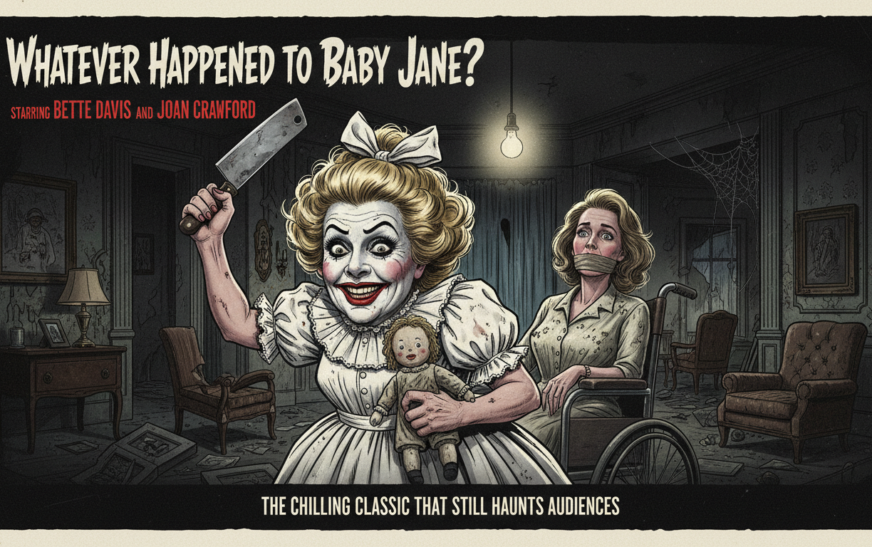
Jane Hudson, a washed‑up former child star, torments her paralysed sister Blanche in a crumbling Hollywood mansion. Blanche, once a glamorous actress, is now confined to a wheelchair. Jane’s actions range from withholding communication, forging signatures, to torturing Blanche psychologically—most memorably, she serves her a dead rat for dinner . The film unfolds as a nonstop spiral of resentment, culminating in a final twist that reframes everything we thought we knew about their grim drama .
Why It Still Terrifies
Campy, But Terrifying
The film is a cornerstone of psycho‑biddy horror, a subgenre that uses aging stars to explore grotesque psychological descent. Bette Davis’s kabuki makeup, Shirley Temple wig, and unnerving baby‑voice heighten the sense of grotesque decay . This isn’t simple camp—it’s psychological horror dressed in vaudeville. The black-and-white cinematography adds to that claustrophobic dread, making every close-up feel like a trap .
Performances That Scorch the Screen
Bette Davis is terrifying as Jane—deranged, unpredictable, and heartbreaking . Joan Crawford brings a stoic vulnerability to Blanche, her silent suffering made more potent by touches like her slow telephone attempt and haunted glances at past glory . It’s this brutal mix of talent and torment that sticks in your head long after the credits roll.
“These scenes feel so real, so lived‑in, that the rivalry and the cruelty cut deeper than any jump‑scare ever could.”
That way of putting it nails why it’s still disturbing—Jane’s cruelty isn’t supernatural. It’s domestic. It makes you squirm.
A Symbol of Hollywood’s Dark Side
Beyond sibling rivalry, the film is a mirror of Hollywood’s cruelty toward aging women. Jane and Blanche led lives defined by beauty and fame; now they’re discarded and trapped in resentful decay . It’s a commentary that hits harder today than ever.
Cultural Afterlife
Upon release, the movie earned five Oscar nominations and won for Best Costume Design in black-and-white . Box-office success followed—it grossed around $9 million on a $1 million budget, giving both leads a surprising late-career boost . Critics’ views originally ranged from disdain to admiration, though recent reviews skew overwhelmingly positive—Rotten Tomatoes now sits around 92% on positive reviews .
The film also spawned its psycho‑biddy legacy. It paved the way for movies about monstrous older women, even influencing modern horror like Misery . Directors such as Akira Kurosawa counted it among favorites—its artistry appeals across cinema cultures .
Why It Still Grips Us
- Relatable horror: There’s something fundamentally terrifying about caregiving turned cruel. It hits close to home.
- Uneasy empathy: You can’t entirely hate Jane—she’s pitiable. That emotional tug is unsettling.
- Perfect storm of performance and design: The makeup, the setting, and those performances feel lived-in, grotesque, yet real.
Conclusion
Baby Jane endures because it taps into deep, uncomfortable emotions: regret, faded glory, and betrayal. Its blend of the grotesque and the vulnerable, the claustrophobic setting, and powerhouse acting make it a movie that stays with you—not just for a scene, but for a lifetime.
FAQs
What genre is What Ever Happened to Baby Jane?
It’s a psychological horror thriller, often classified under the subgenre “psycho‑biddy,” featuring aging women in unstable, psychologically intense roles.
How did audiences receive it when it came out?
It had mixed critical reception at first, but it was a commercial hit and won the Oscar for Best Costume Design in black-and-white. Over time, critical opinion has grown more favorable.
What makes the final twist important?
The twist—Blanche confessing she caused her own accident—reframes the entire story, making the horror both tragic and morally ambiguous.
Why is the film still discussed today?
It resonates for its emotional realism, critique of Hollywood’s treatment of women, and its unforgettable performances and visuals.
Is it more camp or horror?
It’s both. Some scenes feel campy, especially Jane’s act, yet the emotional horror keeps it grounded and disturbing.
What legacy did it leave in cinema?
It launched a wave of similar films starring women past their prime in terrifying roles and influenced later horror like Misery. It remains a touchstone in discussions of aging and representation in Hollywood.