
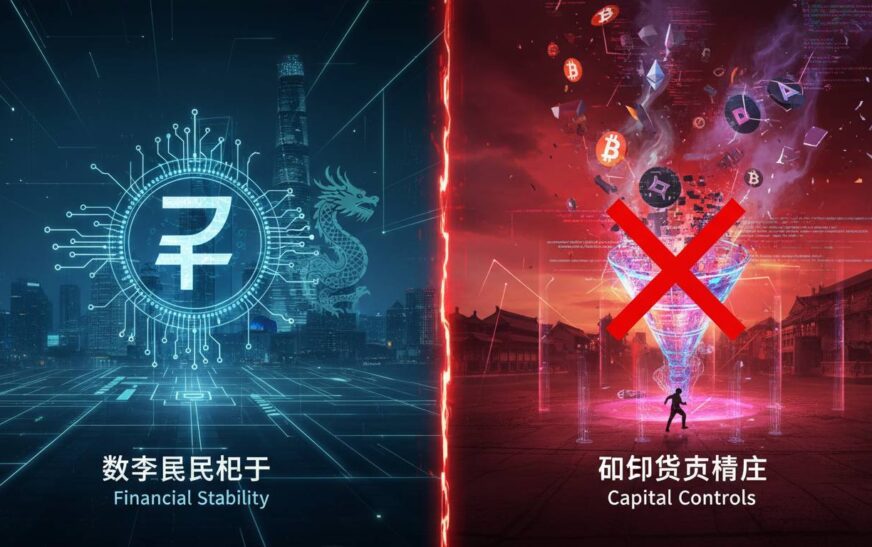
China’s National People’s Congress (NPC) has reinforced a sweeping crackdown on private crypto activity, particularly targeting yuan-pegged stablecoins and real-world asset (RWA) tokenization. This move underscores Beijing’s commitment to preserving monetary sovereignty through the expansion of its digital yuan (e‑CNY) while shutting down parallel crypto channels. The implications for global crypto markets and U.S. stakeholders are significant.
China’s Latest Crypto Clampdown
In a joint notice issued on February 6, 2026, the People’s Bank of China (PBOC) and multiple regulatory bodies banned the unapproved issuance of renminbi‑pegged stablecoins—both domestically and offshore. The notice also classified most RWA tokenization as illegal financial activity unless explicitly approved by authorities .
This regulatory tightening aims to eliminate speculative crypto activity and prevent capital flight through private stablecoins. It reinforces China’s long-standing prohibition on crypto trading, mining, and DeFi operations, extending enforcement to overseas operations tied to Chinese entities .
The Rise of the e‑CNY: A State-Controlled Alternative
As private stablecoins are pushed out, China is promoting its central bank digital currency, the e‑CNY, as the sanctioned alternative. Starting January 2026, commercial banks began offering interest-bearing e‑CNY wallets, transforming the digital yuan into a “digital deposit currency” with features akin to commercial bank liabilities .
The upgraded e‑CNY 2.0 supports smart contracts and institutional use cases, enhancing its appeal and reinforcing state control over digital financial infrastructure .
Why “Stable Yuan, Shrinking Flight” Matters
Preserving Monetary Sovereignty
China views private stablecoins as threats to its monetary control. By banning yuan-linked stablecoins, Beijing aims to prevent unregulated capital flows and maintain strict oversight over digital currency circulation .
Consolidating the Digital Yuan Ecosystem
The crackdown clears the way for the e‑CNY to become the dominant digital currency in China. With interest-bearing capabilities and smart contract support, the e‑CNY is positioned as a secure, state-approved alternative to private stablecoins .
Impact on Crypto Innovation
While China continues to support blockchain technology, private crypto innovation is being channeled into state-sanctioned infrastructure. Firms must pivot from decentralized models to serving the e‑CNY ecosystem as technology providers .
Implications for U.S. and Global Stakeholders
U.S. Crypto Markets
The U.S. crypto industry may benefit from China’s retreat from private stablecoins. However, the U.S. still faces regulatory uncertainty. For instance, the GENIUS Act—proposing stablecoin regulation—remains stalled, potentially delaying U.S. innovation in this space .
Global Stablecoin Landscape
China’s clampdown contrasts with other regions. While Asia tightens, Europe is advancing digital currency initiatives like the digital euro, and the U.S. continues to debate stablecoin frameworks .
Capital Flight and Compliance
The ban targets offshore yuan stablecoins to prevent capital flight. Firms using such instruments for cross-border settlement must reassess strategies and consider migrating to regulated alternatives like the e‑CNY .
Expert Perspectives
According to Winston Ma, adjunct professor at NYU Law School, the ban applies to both onshore and offshore versions of the yuan (CNY and CNH), reinforcing the comprehensive nature of the crackdown .
Jamie Green, COO at Superset, describes the move as “regulatory enclosure,” where the state forces nascent industries into state-approved frameworks .
Christian Ruz, business strategy director at Hype, notes that Chinese investors are accustomed to restrictions and may shift toward U.S.-pegged stablecoins despite the ban .
Future Outlook
- The e‑CNY is likely to gain traction in domestic and cross-border transactions, especially with interest-bearing features and smart contract support.
- Private stablecoin and RWA tokenization initiatives will either seek regulatory approval or pivot to technology services within the e‑CNY ecosystem.
- U.S. policymakers may face increased pressure to clarify stablecoin regulation to maintain competitiveness in digital finance.
Conclusion
China’s NPC-backed crackdown on private stablecoins and RWA tokenization marks a decisive shift in its crypto policy. By reinforcing monetary sovereignty and promoting the e‑CNY, Beijing is reshaping the digital currency landscape. For U.S. and global stakeholders, this signals both a challenge and an opportunity: a challenge in navigating shifting regulatory terrain, and an opportunity to lead in regulated, innovation-friendly crypto markets.
Frequently Asked Questions
What does “stable yuan, shrinking flight” refer to?
It refers to China’s crackdown on private yuan-pegged stablecoins (“stable yuan”) and efforts to curb capital flight through crypto channels (“shrinking flight”), while promoting its digital yuan (e‑CNY).
Why did China ban yuan-linked stablecoins?
China banned them to protect monetary sovereignty, prevent unregulated capital flows, and reinforce control over digital currency issuance.
What is the e‑CNY 2.0?
The upgraded digital yuan supports interest-bearing wallets, smart contracts, and institutional features, positioning it as a regulated alternative to private stablecoins.
How does this affect U.S. crypto markets?
It may shift global stablecoin demand toward U.S. markets, but U.S. regulatory uncertainty—such as delays in the GENIUS Act—could limit this advantage.
Can Chinese firms still issue tokenized assets?
Only with explicit regulatory approval. Most RWA tokenization is now classified as illegal unless conducted within approved infrastructure.
What should investors and firms do?
They should audit exposure to yuan-pegged stablecoins, assess compliance risks, and consider migrating to regulated digital currency frameworks like the e‑CNY.