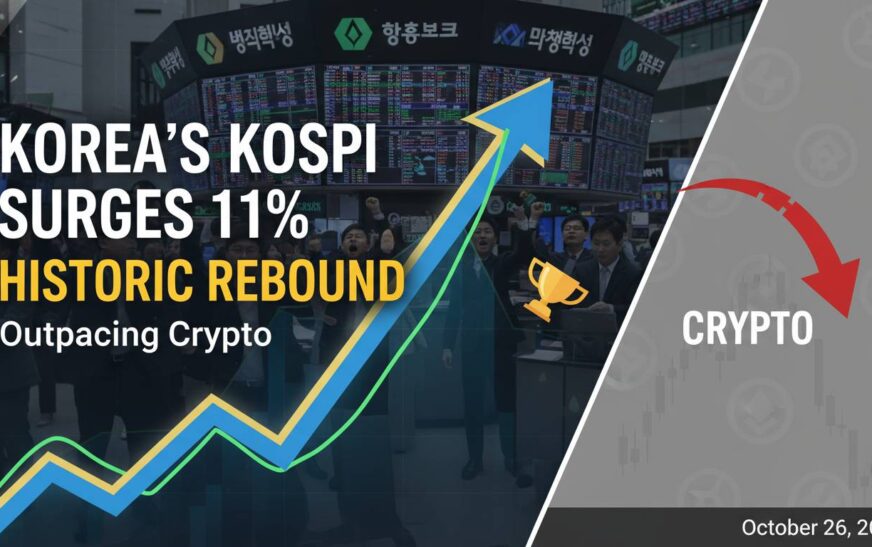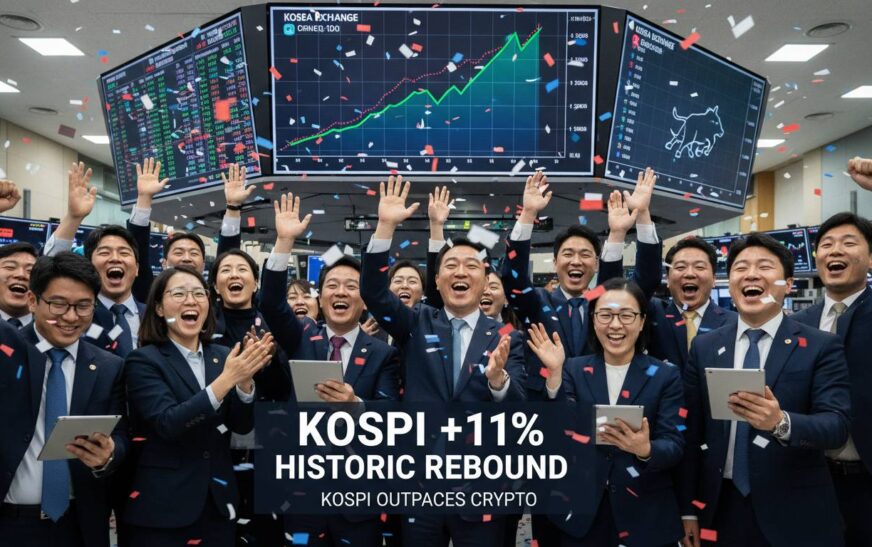

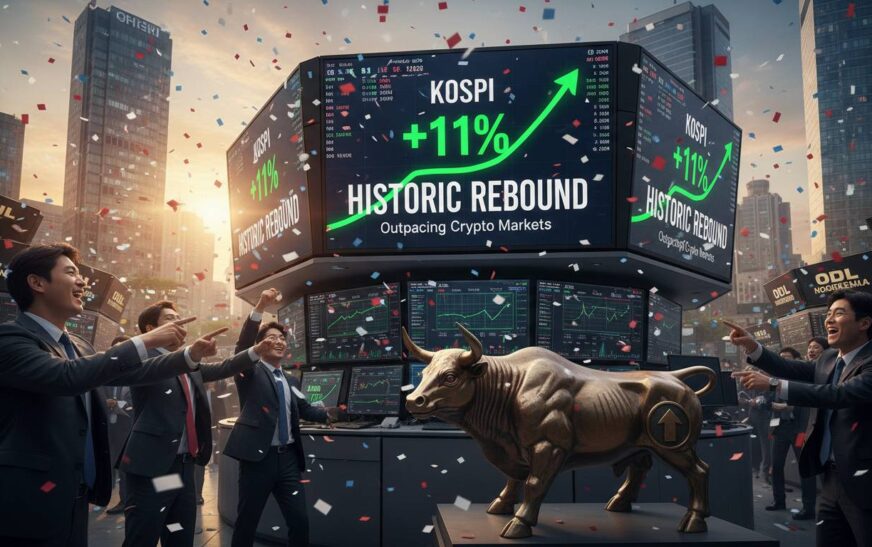
South Korea’s benchmark KOSPI index staged a dramatic comeback on March 5, 2026, soaring more than 11% in a single session—one of its most remarkable reversals ever. This surge not only eclipsed recent crypto gains but also underscored the resilience of equities amid geopolitical turbulence.
Dramatic Rebound in Korea’s KOSPI Surges 11% in Historic Rebound, Outpacing Crypto
One day after suffering its worst single-session loss on record, the KOSPI rebounded sharply, climbing from a close of 5,093 to an intraday high of 5,715 before settling around 5,682. This 11% gain marked one of the steepest recoveries in the index’s history .
The rebound was fueled by stabilizing oil prices—Brent crude held at $81.40 and WTI at $74.66—and reports of back-channel diplomacy between Washington and Tehran, which eased fears of a prolonged Middle East crisis .
Market Drivers and Investor Behavior
Semiconductor giants Samsung Electronics and SK Hynix led the charge, rebounding 13–15% after steep losses of over 20% in recent days. Foreign investors returned as net buyers of more than 710 billion won, while retail investors added another 600 billion won in early trading .
The won also strengthened significantly, pulling back from 1,505 to around 1,461 per dollar. This currency recovery dampened crypto gains: Bitcoin rose 6.4% in dollar terms but only about 5% in won terms, as the stronger won absorbed some of the upside .
Context: Why This Rebound Matters
Geopolitical Sensitivity Amplifies Volatility
South Korea’s heavy reliance on Middle East energy—over 70% of its imports—makes it highly vulnerable to geopolitical shocks. The two-day selloff on March 3–4 resulted in KOSPI and KOSDAQ plunging 18.43% and 17.97%, respectively—the worst and second-worst performances globally during that period .
Equities Outshine Crypto
While equities rebounded sharply, crypto markets lagged. The sharp equity recovery and currency appreciation reduced the appeal of digital assets. Crypto trading volumes in Korea had already dropped over 80% during the KOSPI’s broader bull run, and the V-shaped rebound threatens to further divert capital away from crypto .
Broader Market Momentum and Structural Drivers
Record Highs and AI-Driven Rally
Earlier in 2026, the KOSPI surpassed the 6,000-point milestone and even broke above 6,300, driven by AI enthusiasm and strong earnings from semiconductor and auto sectors. This rally positioned South Korea as one of the world’s best-performing markets .
Structural Tailwinds
The broader rally has been underpinned by AI-led demand for semiconductors, easing U.S.–China trade tensions, and pro-shareholder reforms. SK Hynix posted record Q3 revenue and operating profit, while Samsung also delivered strong returns. These factors helped lift the KOSPI by over 66% in 2025 .
Implications for Stakeholders
Retail and Foreign Investors
The rebound underscores the nimbleness of Korean retail investors, who swiftly shifted from panic selling to aggressive buying. Foreign investors also returned, signaling renewed confidence in Korean equities .
Crypto Market Impact
The equity rally and currency strength have diminished crypto’s appeal. With trading volumes already down sharply, the crypto market faces further headwinds as investor attention shifts back to equities .
Policy and Monetary Outlook
The Bank of Korea may face pressure to tighten monetary policy if the wealth effect from soaring equities fuels inflation. Analysts caution that future gains will depend heavily on geopolitical developments and whether the current rally can sustain momentum .
Conclusion
South Korea’s KOSPI staged a historic rebound, surging over 11% in a single session on March 5, 2026—outpacing crypto markets and reaffirming the dominance of equities amid geopolitical volatility. Driven by semiconductor strength, investor confidence, and easing energy tensions, the rally highlights the resilience of Korea’s stock market. While crypto markets continue to lag, the equity boom may reshape investor preferences in the near term. The path ahead hinges on geopolitical stability, monetary policy response, and whether the AI-driven rally can broaden beyond mega-cap tech.
Frequently Asked Questions
What triggered the KOSPI’s 11% surge?
The rebound followed a record single-session loss and was driven by stabilizing oil prices, easing geopolitical tensions, and strong buying from both foreign and retail investors .
How did crypto markets perform during this rebound?
Bitcoin rose 6.4% in dollar terms but only about 5% in won terms due to the won’s appreciation. Crypto trading volumes in Korea have also declined significantly, reducing the asset class’s appeal .
Which sectors led the KOSPI’s recovery?
Semiconductor giants Samsung Electronics and SK Hynix led the rebound, gaining 13–15% after recent steep losses .
Could this rally lead to inflation or policy changes?
Yes. The wealth effect from soaring equities may pressure the Bank of Korea to consider tightening monetary policy if inflationary pressures emerge .
Is the crypto market likely to recover soon?
Recovery depends on whether investor sentiment shifts back toward digital assets. For now, equities dominate, and crypto remains sidelined amid reduced liquidity and investor interest .
What’s next for the KOSPI?
Analysts are cautiously optimistic. If geopolitical risks ease further, the KOSPI may continue its upward trajectory. However, sustained gains will require broader participation beyond mega-cap tech and continued economic stability.