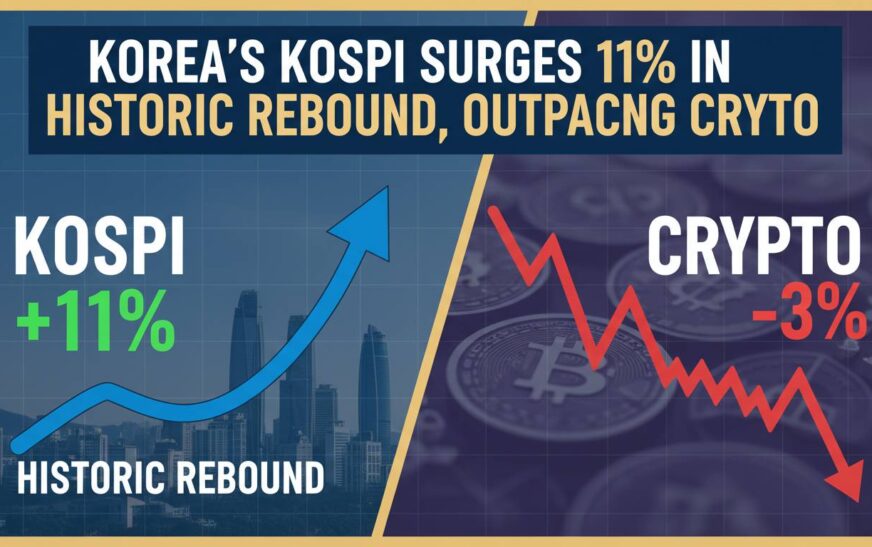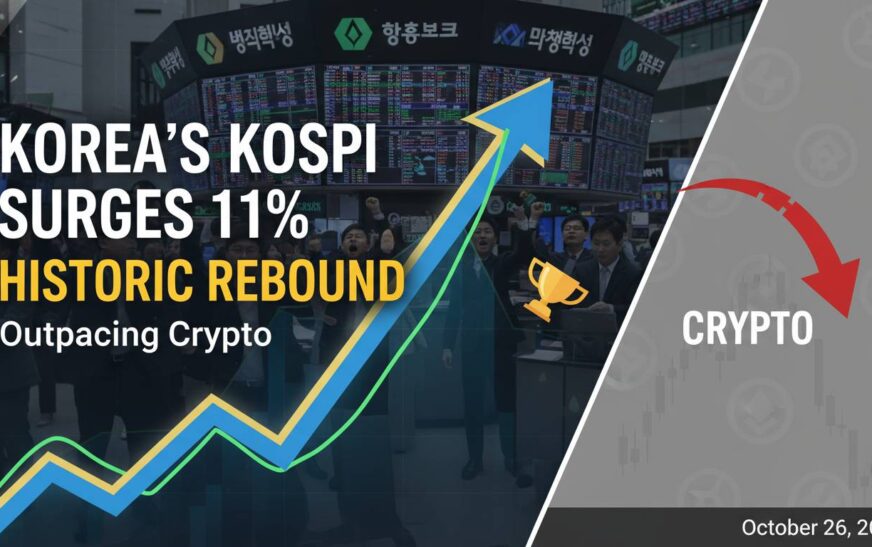

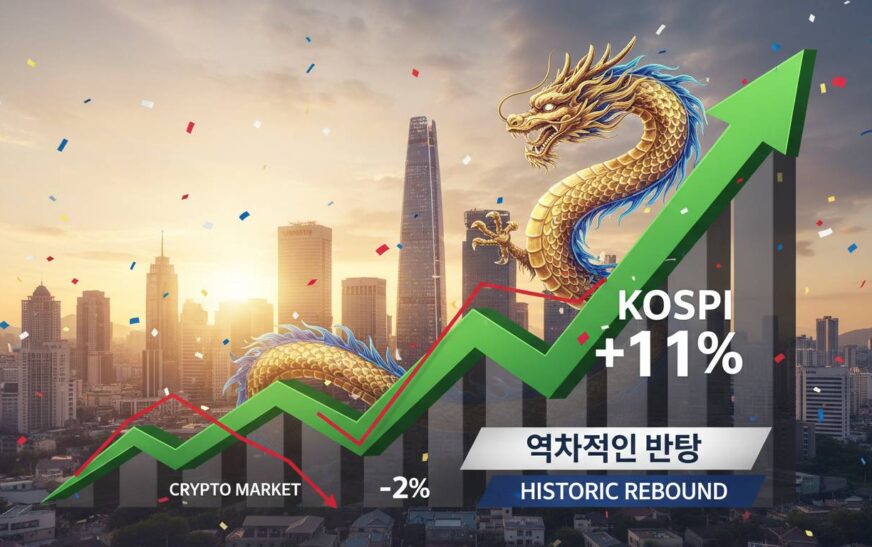
South Korea’s benchmark KOSPI index staged a dramatic comeback on March 5, 2026, soaring over 11% in a single session—one of its most remarkable reversals ever. The surge followed the index’s worst-ever one-day drop, signaling renewed investor confidence amid easing geopolitical tensions and a rebound in tech heavyweights. Meanwhile, cryptocurrency markets lagged behind, underscoring equities’ renewed dominance in South Korea’s risk-on sentiment.
Dramatic Rebound in Korea’s KOSPI
One day after suffering its steepest single-session loss in history, the KOSPI rebounded sharply, climbing from a close of 5,093 to an intraday high of 5,715 before settling near 5,682—an increase exceeding 11% . The tech-heavy KOSDAQ index also recovered, rising above the 1,000 level with gains of over 11% .
This rebound was triggered by stabilizing oil prices—Brent crude held at $81.40 and WTI at $74.66—and reports of back-channel diplomacy between Washington and Tehran, which lifted market sentiment across Asia .
Tech Titans Lead the Charge
Major semiconductor firms Samsung Electronics and SK Hynix, which had plunged 21% and 22.75% respectively from late-February peaks, surged between 13% and 15% in early trading . Foreign investors returned as net buyers, injecting over 710 billion won into equities, while retail investors added another 600 billion won .
Why Korea Fell Harder—and Rebounded Faster
South Korea’s heavy reliance on Middle East energy—over 70% of its imports—made it especially vulnerable to the Iran-related shock that triggered the initial plunge . The two-day drop of 18.43% in KOSPI and 17.97% in KOSDAQ were the worst and second-worst performances globally during that period .
Crypto Markets Lag Behind
While equities rebounded, cryptocurrencies failed to keep pace. Bitcoin rose approximately 6.4% in U.S. dollar terms, but only about 5% in Korean won terms due to the won’s sharp appreciation—from 1,505 to around 1,461—dampening gains for local investors .
This divergence underscores a broader trend: equities, especially tech-driven ones, are regaining favor among South Korean investors, while crypto remains sidelined amid volatility and reduced liquidity .
Broader Context: Equities vs. Crypto in South Korea
Equities Rally Fueled by AI and Policy
Throughout 2025, the KOSPI surged over 70% year-to-date, driven by investor enthusiasm for AI chipmakers like Samsung and SK Hynix . Daily trading volumes ballooned to KRW 34.04 trillion—up 208% from early January—while crypto volumes on major exchanges plunged to KRW 5.57 trillion, a 45% decline .
Retail Investors Shift from Crypto to Stocks
Retail participation in equities soared, with active brokerage accounts rising from 86.5 million to 95.3 million. Margin lending and leveraged ETF demand reached record levels . Meanwhile, crypto trading volumes on platforms like Upbit and Bithumb fell by up to 80% year-on-year .
Structural Reforms and AI Tailwinds
South Korea’s equity rally is also underpinned by government-led reforms aimed at closing the “Korea Discount,” improving corporate governance, and boosting shareholder returns . The global AI boom continues to drive demand for memory chips, benefiting Samsung and SK Hynix .
Analysis: What This Means for Investors
- Equities regain center stage: The KOSPI’s sharp rebound highlights renewed investor confidence in traditional markets, especially in tech and semiconductors.
- Crypto remains volatile: With crypto gains muted by currency movements and declining volumes, digital assets appear less attractive in the current environment.
- Geopolitical sensitivity persists: Korea’s market remains highly reactive to global shocks, particularly energy-related disruptions.
- Policy and reform matter: Structural improvements and AI-driven growth are reinforcing equities’ appeal, potentially sustaining the rally.
Conclusion
South Korea’s KOSPI delivered a historic rebound—surging over 11% in a single session—outpacing crypto markets and reaffirming equities’ dominance in the current investment landscape. Tech giants led the charge, buoyed by policy support and AI tailwinds, while crypto markets struggled amid reduced liquidity and currency headwinds. As geopolitical risks ease and reforms take hold, equities may continue to attract capital, though volatility remains a defining feature of Korea’s dynamic markets.
Frequently Asked Questions
What caused the KOSPI’s 11% surge?
The rebound followed a record one-day drop and was driven by stabilizing oil prices, easing geopolitical tensions, and strong gains in semiconductor stocks like Samsung and SK Hynix .
How did cryptocurrencies perform during the rebound?
Bitcoin rose about 6.4% in dollar terms but only around 5% in won terms, as the Korean currency strengthened, reducing gains for local investors .
Why did South Korean investors shift from crypto to stocks?
Equities offered stronger returns, particularly in AI-linked sectors, while crypto volumes declined sharply—up to 80% year-on-year on major exchanges .
What role did government reforms play in the rally?
Reforms targeting corporate governance, shareholder returns, and market infrastructure helped close valuation gaps and attract investor interest .
Is the KOSPI rebound sustainable?
While the rally is supported by structural reforms and AI momentum, Korea’s market remains sensitive to geopolitical shocks and energy price volatility .
What should investors watch next?
Key indicators include global geopolitical developments, oil price trends, semiconductor earnings, and continued policy reforms—all of which will shape market direction.