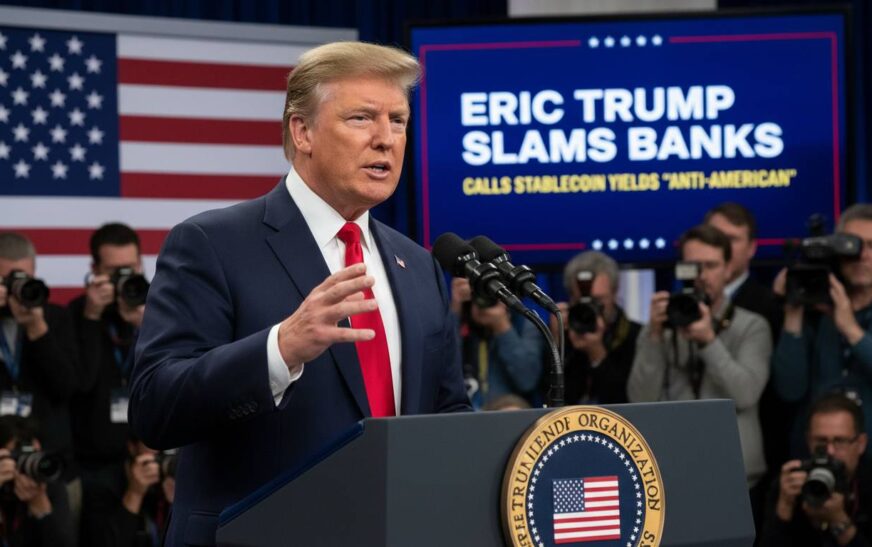

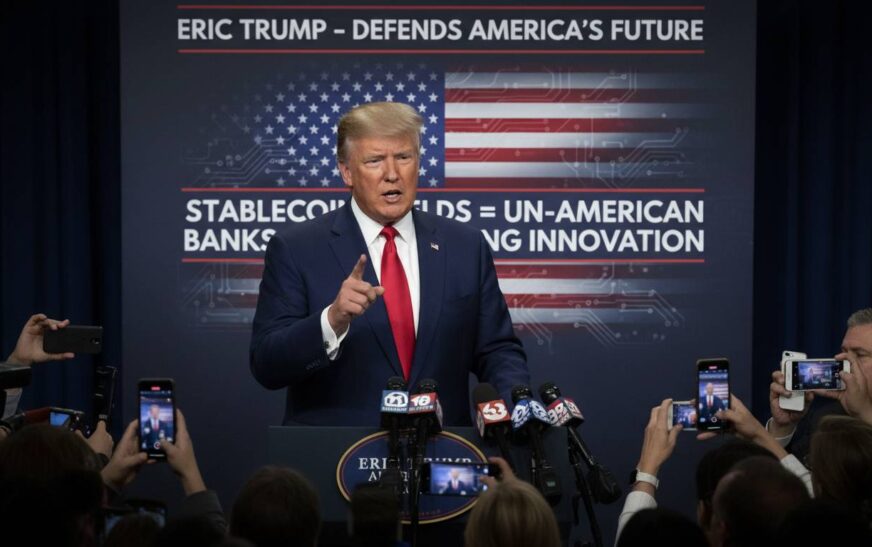
Eric Trump accuses major U.S. banks of lobbying to block stablecoin yields, calling their actions “anti‑American.” He argues that while banks benefit from high Federal Reserve rates, they offer savers near-zero returns. This clash spotlights the growing tension between traditional finance and the crypto industry amid stalled legislation and mounting stakes.
Banks Oppose Stablecoin Yields, Trump Fires Back
Eric Trump, co‑founder of World Liberty Financial (WLF), took to X on March 4, 2026, to denounce major banks—including JPMorgan Chase, Bank of America, and Wells Fargo—for lobbying against stablecoin yield provisions in pending legislation. He criticized the American Bankers Association and other groups for spending millions to restrict stablecoin rewards, framing their efforts as a defense of low-rate structures that disadvantage consumers. “This is anti‑retail, anti‑consumer, and straight‑up anti‑American,” he wrote.
Trump highlighted the disparity between what banks earn from the Federal Reserve—over 4%—and what they offer depositors, typically just 0.01% to 0.05%. He argued that stablecoin platforms offering 4%–5% yields pose a competitive threat, prompting banks to lobby for restrictions.
The Legislative Battleground: GENIUS Act and Clarity Act
The controversy unfolds amid legislative negotiations over the U.S. crypto market structure. The GENIUS Act, passed in July 2025, allows banks and financial institutions to issue stablecoins backed by fiat or high-quality collateral like U.S. Treasuries—but explicitly prohibits yield-bearing stablecoins.
Meanwhile, the Clarity Act, passed by the House, contains similar restrictions. Banking groups are pushing for these provisions to be maintained in the Senate’s market structure bill, arguing that high-yield stablecoins could destabilize the banking system.
Stakes for World Liberty Financial and USD1
World Liberty Financial, co-founded by Eric Trump, launched its USD1 stablecoin in March 2025. The coin is backed by U.S. Treasuries and cash equivalents and has already seen institutional adoption—most notably, a $2 billion investment in Binance by Abu Dhabi’s MGX.
WLF also applied for a national banking license in January 2026, which would allow it to issue and safeguard USD1.
The outcome of the yield debate directly affects USD1’s competitiveness. If stablecoin yields are banned, USD1 loses a key advantage over traditional bank deposits.
Banking Industry’s Concerns and Counterarguments
Banking executives warn that interest-bearing stablecoins could siphon off trillions in deposits, reducing lending capacity and raising borrowing costs. Bank of America’s CEO, Brian Moynihan, estimated that up to $6 trillion could shift from banks to stablecoins if yields are allowed.
The Treasury Department has echoed these concerns, estimating potential deposit outflows of up to $6.6 trillion.
Banks argue that stablecoin holdings lack FDIC insurance, exposing consumers to risk. They also warn that deposit migration could undermine funding for mortgages and small-business loans, slowing economic growth.
Expert Perspectives and Industry Tensions
According to industry observers, the banking sector is in “panic mode” over the rise of yield-bearing stablecoins. NYU fintech consultant Austin Campbell described the banks’ lobbying as an attempt to preserve their cartel-like dominance.
Crypto advocates counter that yield programs simply introduce much-needed competition, pressuring banks to offer better rates to savers.
Analysis: What’s at Stake and What Comes Next
This clash represents more than a financial dispute—it reflects a broader ideological battle over the future of money and financial inclusion.
- Consumer Choice vs. Stability: Stablecoin yields offer savers higher returns, but regulators and banks warn of systemic risks.
- Regulatory Precedent: How Congress resolves this could set the tone for future crypto regulation.
- Market Dynamics: If yield-bearing stablecoins are allowed, they may accelerate deposit migration and reshape banking.
- Political Overtones: Eric Trump’s rhetoric frames the issue as a fight for American consumers, but critics see it as self-serving, given his financial interests in USD1.
Conclusion
Eric Trump’s sharp rebuke of major banks—calling their opposition to stablecoin yields “anti‑American”—underscores the growing friction between traditional finance and the crypto sector. As lawmakers negotiate the fate of the GENIUS and Clarity Acts, the outcome will determine whether stablecoins can offer competitive yields or remain constrained by legacy banking interests. The stakes are high: for consumers, for the banking system, and for the future of digital finance.
Frequently Asked Questions
What did Eric Trump say about banks and stablecoin yields?
Eric Trump accused major banks and lobby groups of spending millions to block stablecoin yield provisions, calling their actions “anti‑American.” He argued they profit from high Fed rates while offering savers near-zero returns.
What are the GENIUS Act and Clarity Act?
The GENIUS Act, passed in July 2025, allows banks to issue stablecoins but prohibits yield-bearing versions. The Clarity Act, passed by the House, includes similar restrictions. Both are central to ongoing Senate negotiations.
Why are banks opposed to yield-bearing stablecoins?
Banks warn that high-yield stablecoins could draw trillions in deposits away, reducing lending capacity and increasing borrowing costs. They also cite consumer risk due to lack of FDIC insurance.
How does this affect World Liberty Financial and USD1?
World Liberty Financial’s USD1 stablecoin offers competitive yields and is backed by U.S. Treasuries. Restrictions on yields would weaken its appeal compared to traditional bank deposits.
What are the broader implications of this conflict?
The outcome will influence consumer choice, banking stability, regulatory precedent, and the evolution of digital finance. It also highlights the tension between innovation and institutional protectionism.
What’s next in the legislative process?
Senate negotiations over the market structure bill continue. The fate of yield-bearing stablecoins hinges on whether lawmakers side with banking stability or crypto innovation.