
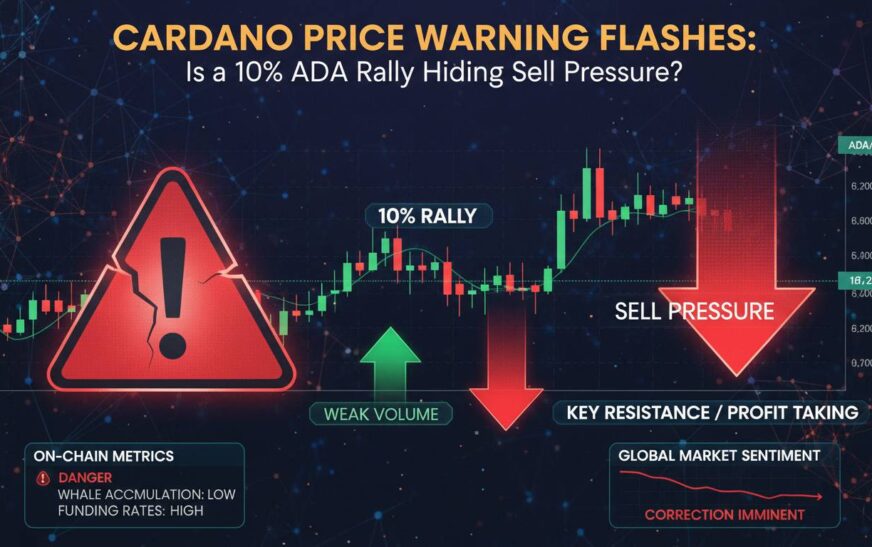
An unexpected 10% rally in Cardano (ADA) has captured attention—but beneath the surface, warning signs are emerging. Recent data reveals that while ADA’s price surged, large holders have been offloading significant volumes, raising concerns about a potential sell wave. This article explores the dynamics behind the rally, the risks ahead, and what investors should watch next.
Rally Amid Rising Sell Pressure
In early March 2026, Cardano experienced a sharp rally of nearly 24%, only to see a swift reversal. On-chain data shows that during this rally, whales—large ADA holders—sold approximately 2.15 billion ADA, equating to around $540 million in sell pressure. This triggered a 17% price collapse shortly after the peak, signaling that the rally may have been a distribution event rather than a sustainable uptrend .
Compounding the concern, trading volume has collapsed by 45–55%, indicating waning market participation. This volume decline suggests that the rally lacked broad support and may have been driven by short-term speculative activity .
Technical Breakdown and Derivatives Pressure
Technically, ADA remains trapped below key resistance levels between $0.30 and $0.31. Attempts to break higher have repeatedly failed, reinforcing the bearish structure . Momentum indicators further confirm the downtrend: ADA trades below the 26-, 50-, and 200-day EMAs, with no convincing breakout in sight .
On the derivatives front, negative funding rates have flipped bearish, signaling that shorts are now paying longs. This shift often intensifies downward pressure, especially in low-liquidity environments like ADA’s current market .
Historical Whale Activity and Sell-Off Patterns
This recent sell-off is not an isolated event. In late 2025, whales unloaded over 140 million ADA within two weeks, even as technical indicators flashed bullish signals like RSI strength and MACD crossovers. Analysts at the time warned that such distribution could undermine rally sustainability .
Earlier in 2025, large wallets holding between 1 million and 100 million ADA trimmed their holdings by 390 million ADA, while those holding over 100 million ADA increased theirs slightly—highlighting a shift in sell-side pressure among mid-tier holders .
Implications for Stakeholders
- Retail Investors: The rally may have created a false sense of security. With whales offloading during the upswing, retail participants risk buying into a distribution phase rather than a genuine recovery.
- Traders: The technical breakdown and derivatives pressure suggest that downside risk remains elevated. A 10% correction toward $0.24 is a realistic scenario unless ADA can reclaim $0.29 with conviction .
- Long-Term Holders: While Cardano’s fundamentals remain intact, the current market structure underscores the importance of patience and caution. Short-term volatility may continue until broader participation returns.
Analysis and Outlook
The 10% ADA rally appears to be masking deeper vulnerabilities. Heavy whale selling, collapsing volume, and bearish technicals all point toward a fragile market structure. The rally may have been a classic “sell the news” event—where large holders capitalize on short-term price spikes.
For the rally to regain credibility, ADA must:
- Reclaim and hold above $0.29 to invalidate the immediate bearish bias .
- See a rebound in trading volume and on-chain activity to signal renewed interest.
- Show sustained buying from smaller holders rather than continued distribution from whales.
Absent these developments, ADA may continue to drift lower, potentially testing the $0.24 support zone or even revisiting February’s lows near $0.22 .
Conclusion
The recent 10% rally in Cardano may be more illusion than substance. Beneath the surface, whale selling, declining volume, and bearish technical indicators suggest that the rally could be masking a rising sell wave. Investors and traders should remain cautious and monitor key levels closely. A sustained recovery will require renewed buying interest and a shift in on-chain dynamics. Until then, downside risks remain elevated.
Frequently Asked Questions
What triggered the recent ADA rally and subsequent decline?
The rally was followed by a massive whale sell-off—2.15 billion ADA (~$540 million)—which triggered a 17% price collapse. Volume also collapsed, signaling weak market support .
Is the 10% rally sustainable?
Current data suggests it may not be. Heavy distribution by large holders and bearish technical indicators point to a fragile rally that could reverse further .
What are the key technical levels to watch?
ADA needs to reclaim $0.29 to invalidate the bearish setup. If it fails, a correction toward $0.24 or lower remains likely .
How does whale activity affect ADA’s price?
Whale selling during rallies increases supply pressure and often precedes price drops. Sustained distribution undermines price structure and investor confidence .
Should retail investors be concerned?
Yes. Retail investors may be buying into a rally that large holders are exiting. Caution and close monitoring of on-chain and technical signals are advised.
What could signal a genuine recovery?
A rebound in trading volume, sustained buying from smaller holders, and a successful break above $0.29 would be positive signs. Without these, downside risk remains elevated.