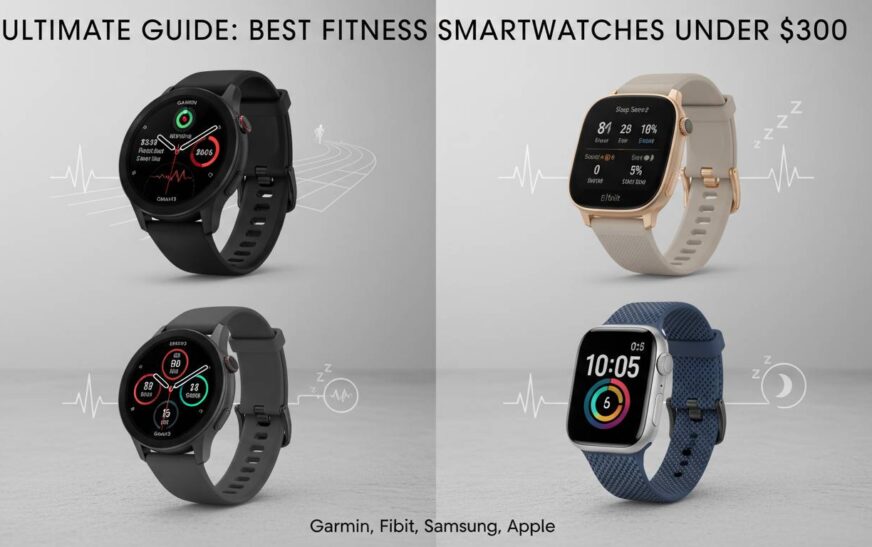

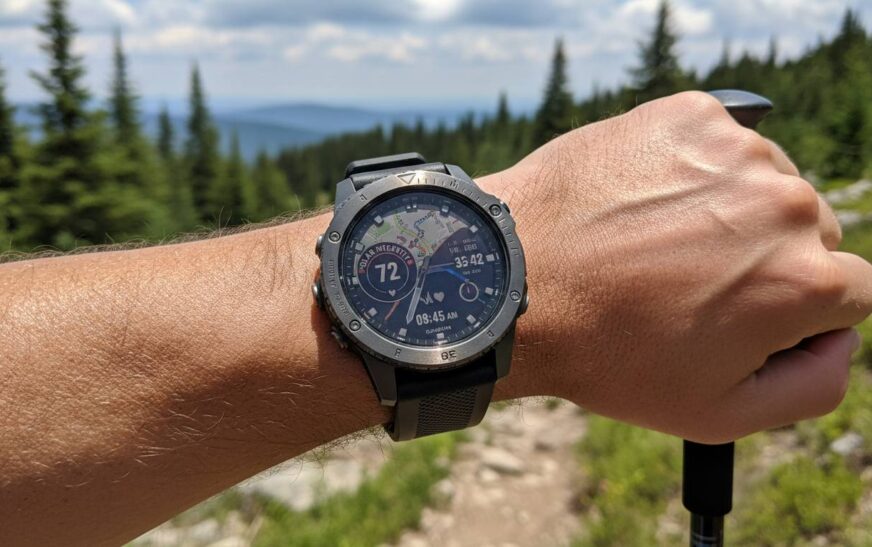
Finding the right smartwatch can feel overwhelming, especially when you want something that actually delivers on its fitness promises. After testing dozens of options across different price points, I’ve compiled this guide to help you find the right one. Whether you’re training for a marathon, lifting weights, or just want to track your daily activity, this list covers solid options for men who take their fitness seriously.
Why Fitness Smartwatches Matter for Men
Let’s be real — most guys buy a smartwatch thinking they’ll use all those fitness features, and then three months later they’re just checking notifications. But here’s the thing: when you actually use a quality fitness smartwatch the right way, it changes how you train. You start paying attention to heart rate zones, recovery time, and sleep quality. That’s where the real value lies.
Modern fitness watches do way more than count steps. We’re talking about advanced metrics like VO2 max estimation, blood oxygen monitoring, ECG capabilities, and GPS tracking precise enough to map your running route down to the meter.
The market has gotten crowded. Apple dominates the mainstream, Garmin rules the serious athlete space, Samsung makes good watches, and companies like Fitbit and COROS offer alternatives. Each brand has its strengths, and the “best” really depends on what you’re training for and how you like to train.
How I Tested These Smartwatches
I spent the last six months putting these watches through their paces. Real-world testing is what matters here — not just specs on a page. I wore each watch during weight training sessions, long runs, cycling workouts, and while sleeping to check overnight metrics.
My testing criteria focused on what actually matters for fitness: heart rate accuracy during high-intensity intervals, GPS precision on outdoor runs, battery life when you’re mid-marathon, and overall durability. I also considered how intuitive the companion apps are, because even the most powerful watch is useless if you never sync it or dig into the data.
Price-to-value ratio played a big role too. A $1,000 watch might be incredible, but if a $300 watch does 90% of what that premium option does, I wanted to highlight that difference.
Best Overall: Apple Watch Series 9
The Apple Watch Series 9 isn’t just the most popular smartwatch — it’s genuinely one of the best fitness trackers you can buy. Apple has refined this thing to where it works for the casual walker and the serious athlete alike.
What makes it stand out for fitness? The S9 chip brings faster processing, which means apps load quickly and health metrics calculate in real-time. The double-tap gesture is useful when you’re mid-workout and don’t want to touch the screen with sweaty fingers. You can start a workout, pause it, or scroll through stats with one hand.
The fitness features include everything: GPS tracking, heart rate monitoring with irregular rhythm notifications, blood oxygen sensing, temperature tracking for sleep tracking, and sleep stages. The Workout app covers just about every activity — from traditional running and cycling to rowing, functional strength training, and recreational sports.
Battery life is where Apple still lags behind dedicated fitness watches. You’re looking at about 18 hours with regular use, maybe 36 if you’re really conservative. That means charging it daily if you track workouts and sleep. For some guys, that’s a dealbreaker. For others, it’s just part of the ecosystem.
Pros: Great app ecosystem, fast performance, easy to use, doubles as a general smartwatch, sharp display
Cons: Daily charging required, no built-in GPS (needs phone), limited to iPhone users
Price: Starts at $399
Best for Serious Runners: Garmin Forerunner 965
If you’re the kind of guy who trains for races, follows a structured plan, and actually analyzes your training data, the Garmin Forerunner 965 is built for you. This is a running watch that happens to do smartwatch things — not the other way around.
The Forerunner 965 improves on its predecessor with a brighter AMOLED display (finally — older Forerunners had dim LCD screens), titanium bezel for that premium feel without much weight, and 23 days of battery life in smartwatch mode. But where it really shines is GPS mode: you get up to 31 hours. That’s enough for a 100-mile ultramarathon without worrying about battery.
The training features are where this watch earns its keep. You’ve got morning report giving you a daily readiness score based on sleep, HRV, and recovery. Training status tells you if you’re peaking, maintaining, or overtraining. Race predictor estimates your finish times for various distances. And ClimbPro shows grade-adjusted pace when you’re running hills, so you can train smarter on varied terrain.
For strength training, Garmin has improved muscle mapping so you can track which muscle groups you’re hitting and their fatigue levels throughout a session. It’s not perfect, but it’s a solid step in the right direction.
Pros: Great battery life, AMOLED display, advanced training metrics, excellent GPS accuracy, lightweight
Cons: Expensive at $599, some features require Garmin Connect subscription, no smart home controls
Price: $599
Best Battery Life: Garmin Fenix 7X Pro Solar
The Garmin Fenix 7X Pro Solar isn’t cheap, but if battery life is your top priority — and for guys who do multi-day backpacking trips or ultra events, it absolutely is — this is the king. With solar charging, you can theoretically get unlimited battery life in the right conditions. Realistically, you’re looking at 28 days in smartwatch mode with solar, and over 150 hours in GPS mode.
This is Garmin’s flagship multisport watch. It’s built like a tank with a titanium bezel and Sapphire crystal glass. It’s water-rated to 10ATM, which means you can swim with it, shower with it, and not worry about rain. The 51mm case is big — if you have smaller wrists, this might look like a dinner plate on your arm. But for guys who want that robust, instrument-style look, it’s perfect.
The fitness features mirror the Forerunner 965 but add topographic maps for hiking and breadcrumb navigation for trail running. You’ve got multi-band GPS for pinpoint accuracy in challenging environments like deep canyons or dense forest. The LED flashlight on this thing is actually useful — bright enough to find your way back to camp or be seen on early morning runs.
The solar charging works, but don’t expect miracles. In direct sunlight with the display facing the sky, you might squeeze out an extra few hours per day. It’s more about not having to charge every few days during extended trips.
Pros: Epic battery life, solar charging, rugged build, topo maps included, LED flashlight, multi-band GPS
Cons: Very expensive at $899, large size not for everyone, heavy at 87g
Price: $899
Best Value: Fitbit Charge 6
Not everyone wants to spend $600 on a fitness tracker. The Fitbit Charge 6 proves you don’t have to. At just $159, this is the best fitness band value going right now, and it’s gotten smarter about bridging the gap between basic tracker and full smartwatch.
The Charge 6 now includes built-in GPS, which was a major missing feature in previous generations. That means you can leave your phone at home and still get accurate distance and pace data on your runs. The heart rate sensor has been improved with a new algorithm that’s noticeably more accurate during high-intensity interval training.
Google integration brings YouTube Music controls and Google Maps navigation right to your wrist. You also get Fitbit’s sleep tracking, which remains one of the best in the industry for this price point. Sleep stages, sleep score, and detailed nightly analysis help you understand your recovery.
The downside is the design. It’s still a fitness band, not a watch. The display is smaller, and you don’t get the same premium feel as an Apple Watch or Garmin. But for the price, the functionality is impressive. Battery life hits about 7 days, which is far more forgiving than daily charging.
Pros: Affordable, built-in GPS now, excellent sleep tracking, 7-day battery, Google integration
Cons: Basic design, smaller display, limited app ecosystem
Price: $159
Best for Android Users: Samsung Galaxy Watch 6 Classic
If you’re in the Android ecosystem, the Samsung Galaxy Watch 6 Classic deserves a hard look. Samsung has really refined their fitness tracking, and the rotating bezel on the Classic model makes navigation intuitive in a way touchscreens can’t match when your hands are sweaty.
The health features are comprehensive: heart rate, ECG, blood pressure (in supported countries), blood oxygen, body composition analysis, and skin temperature monitoring. Samsung’s sleep tracking has improved dramatically, and you now get a sleep score that factors in your time in each sleep stage, plus consistency and wake-up quality.
For workouts, you’ve got automatic detection for most common exercises, manual selection for everything else, and post-workout analysis that shows your heart rate recovery and VO2 max estimate. The GPS works well, though it’s not quite as precise as Garmin’s multi-band system.
The battery life is the sticking point. You’ll get about 40 hours with always-on display, less if you use LTE. That’s competitive with Apple but behind Garmin. The Wear OS platform means you’ve got access to more third-party apps than older Samsung watches.
Pros: Rotating bezel navigation, excellent display, comprehensive health sensors, good Android integration
Cons: Battery life could be better, expensive at $399, some health features limited by region
Price: $399
Best Premium Apple Option: Apple Watch Ultra 2
The Apple Watch Ultra 2 is Apple’s attempt to compete directly with Garmin, and it’s mostly successful. This is the Apple Watch for guys who take their fitness seriously — the one you’d actually consider wearing for a marathon or a backcountry ski trip.
The battery life is dramatically improved over standard Apple Watch. You’re looking at 36 hours in normal use, and there’s a low-power mode that extends it to 72 hours. That’s still not matching Garmin territory, but it’s a massive leap forward for Apple fans.
The design is rugged: 49mm titanium case, sapphire crystal display, and WR100 water resistance (that’s 100 meters, so snorkeling and recreational diving are fine). The action button is customizable — you can program it to start a specific workout, mark a segment, or control a timer without touching the display.
The dual speakers are louder, which matters for taking calls and hearing workout audio cues. The Precision GPS includes L1 and L5 frequencies for better accuracy in challenging environments. And the 3000 nits display is the brightest Apple has ever made, readable in direct sunlight no problem.
Pros: Best Apple battery life, rugged build, precision GPS, action button, bright display
Cons: Expensive at $799, heavy on the wrist, limited to iPhone
Price: $799
Best for Strength Training: Whoop 4.0
Here’s where I might lose some people, because the Whoop 4.0 isn’t a traditional watch at all. There’s no display. You wear it as a band on your wrist or on a special band around your bicep. But if your primary focus is lifting weights and you want data on strain, recovery, and sleep, this is incredibly valuable.
Whoop’s whole thing is the “Strain” and “Recovery” score system. It learns your body’s patterns over time and tells you whether you’re ready to push hard or should take it easy. For strength training specifically, this helps prevent overtraining — the silent killer of progress for guys who train hard but don’t track their recovery.
The 4.0 version improved the sensor accuracy and added an on-demand HRV measurement. The battery lasts about 5 days, and the charging puck makes it easy to top up. The downside is the subscription model — $239 for the device plus $30/month or $199/year for the app access. That adds up fast.
Pros: Excellent strain/recovery tracking, discrete design, great for strength training, comfortable to wear 24/7
Cons: No display, subscription required, not a traditional smartwatch
Price: $239 (plus subscription)
Best Newcomer: COROS Apex 2 Pro
COROS has been quietly building a reputation among serious athletes, and the Apex 2 Pro is their most accessible premium option yet. This is a watch that competes with Garmin but often undercuts them on price while delivering comparable performance.
The battery life is remarkable: 45 days in smartwatch mode, 75 hours in full GPS mode. That’s better than most Garmin watches at a lower price point. The dual-frequency GPS is accurate in challenging environments, and the COROS training software has gotten much better.
For fitness tracking, you’ve got all the basics plus some advanced metrics. The EvoLab training system provides training load, recovery suggestions, and race predictions. It’s not as polished as Garmin’s Connect ecosystem, but it’s functional and improving.
The design is clean and understated — this doesn’t look like a “fitness watch” in the chunky way some Garmins can. At 42g, it’s lightweight, and the 5ATM water resistance handles swimming fine.
Pros: Excellent battery life, accurate GPS, clean design, competitive pricing
Cons: App ecosystem less developed than Garmin, fewer third-party integrations
Price: $399
Best Budget Fitness Watch: Amazfit GTR 4
Amazfit continues to be the budget king, and the GTR 4 shows why. You get a lot of watch for not much money — $199 gets you dual-band GPS, 14-day battery life, and a surprisingly good fitness tracking experience.
The Zepp app that powers Amazfit watches has improved significantly. You’ve got GPS tracking with route mapping, heart rate monitoring, blood oxygen sensing, stress tracking, and sleep analysis. For most casual athletes, this covers everything they’d actually use.
The design is classic watch style — you could wear this with a button-down shirt and not look out of place. The battery genuinely lasts two weeks, which is luxurious compared to daily charging. The downside is the limited third-party app support and less sophisticated training analysis compared to Garmin or COROS.
Pros: Affordable, 14-day battery, classic watch design, dual-band GPS
Cons: App experience not as polished, less advanced training metrics
Price: $199
Best for Outdoor Adventures: Garmin Instinct 2 Solar
The Garmin Instinct 2 Solar is the rugged, outdoor-focused option for guys who’d rather be on a trail than in a gym. It’s built to US military standards for thermal, shock, and water resistance. This is the watch that looks beat up after a year and still works perfectly.
Solar charging extends battery life significantly — Garmin claims unlimited battery life in smartwatch mode with sufficient sun exposure. Realistically, you’ll get several extra days compared to non-solar versions. In GPS mode, you’re looking at around 80 hours with solar.
The fitness features include everything you’d expect: GPS tracking, heart rate, VO2 max, stress tracking, and body battery energy monitoring. But the outdoor features are what set it apart: ABC sensors (altimeter, barometer, compass), TracBack routing to find your way back, and multi-GNSS support for better GPS accuracy.
The design is polarizing — it’s definitely a “tool watch” aesthetic, not something you’d wear to a business meeting. But if that’s the look you’re going for, it’s authentic rather than trying to be something it’s not.
Pros: Rugged build, solar charging, outdoor navigation features, affordable at $399
Cons: Monochromatic display, not dressy
Price: $399
What to Look for in a Fitness Smartwatch
Before you buy, here are the key features that actually matter:
Heart Rate Monitoring: Optical heart rate sensors have gotten good, but they’re not perfect. If you’re doing high-intensity interval training, check reviews for accuracy during rapid heart rate changes. Garmin and Apple generally lead here.
GPS: Built-in GPS means you don’t need your phone for outdoor activities. Single-band GPS works fine in open areas. Dual or multi-band GPS is better in challenging environments like cities with tall buildings or forested trails.
Battery Life: This varies enormously. Some watches need daily charging; others last weeks. Consider how you’ll actually use it. If you hate charging things, prioritize battery life.
Water Resistance: Rating matters here. 5ATM means 50 meters — fine for swimming. WR100 means 100 meters — fine for snorkeling. If you’re diving, you need something more specialized.
Ecosystem: Apple works best with iPhone. Samsung and Google watches work best with Android. Garmin and COROS work with both but offer more advanced fitness features. Consider what phone you’re using.
Companion App: The watch is only half the experience. The app is where you’ll analyze your data over time. Try the free versions before committing to a subscription.
Our Final Recommendation
For most men looking for a fitness smartwatch in 2024, the Apple Watch Series 9 hits the sweet spot of price, performance, and everyday usability. The fitness tracking is comprehensive, the ecosystem is unmatched, and you’ll actually use it as a smartwatch too.
But if you’re a serious runner, the Garmin Forerunner 965 is worth the investment. If battery life is everything, the Garmin Fenix 7X Pro Solar or the budget-friendly Amazfit GTR 4 deliver. And if you’re Android-first, the Samsung Galaxy Watch 6 Classic brings excellent health tracking in a sleek package.
The best watch is the one you’ll actually wear and use. Think about your training style, your budget, and what data matters to you. This guide covers the full spectrum, so whatever you choose, you’re getting a quality device.
FAQs
Which smartwatch has the best fitness tracking accuracy?
Garmin watches generally offer the most accurate fitness tracking, particularly for running and cycling. The Forerunner and Fenix series use multi-band GPS and have the most sophisticated training metrics. However, Apple Watch Series 9 and Samsung Galaxy Watch 6 have improved significantly and are accurate enough for most recreational athletes.
Is Apple Watch good for gym workouts?
Yes, the Apple Watch Series 9 and Ultra 2 work well for gym workouts. The Workout app includes strength training, HIIT, and other gym exercises. The key limitation is that GPS doesn’t work indoors, so distance tracking isn’t available without a connected phone. The strength training feature tracks muscle groups worked, which is helpful for balancing your routine.
How long do fitness smartwatches last?
A quality fitness smartwatch should last 3-5 years with proper care. Battery degradation is typically the limiting factor — most lithium-ion batteries retain about 80% capacity after 500 charge cycles. Garmin watches tend to have better longevity due to their more rugged build and user-replaceable batteries in some models.
Should I buy a fitness band or a smartwatch?
It depends on your needs. Fitness bands like the Fitbit Charge 6 are cheaper, lighter, and have longer battery life, but they offer limited smartwatch features. Smartwatches like Apple Watch or Samsung Galaxy Watch do more (notifications, apps, payments) but cost more and need more frequent charging. If fitness tracking is your priority and you want a traditional watch look, a fitness band or a dedicated sports watch like Garmin is better value.