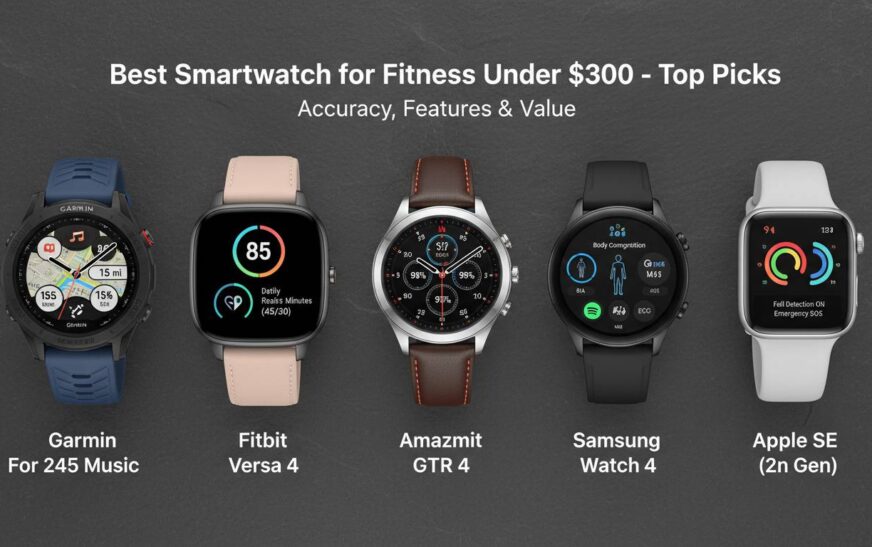

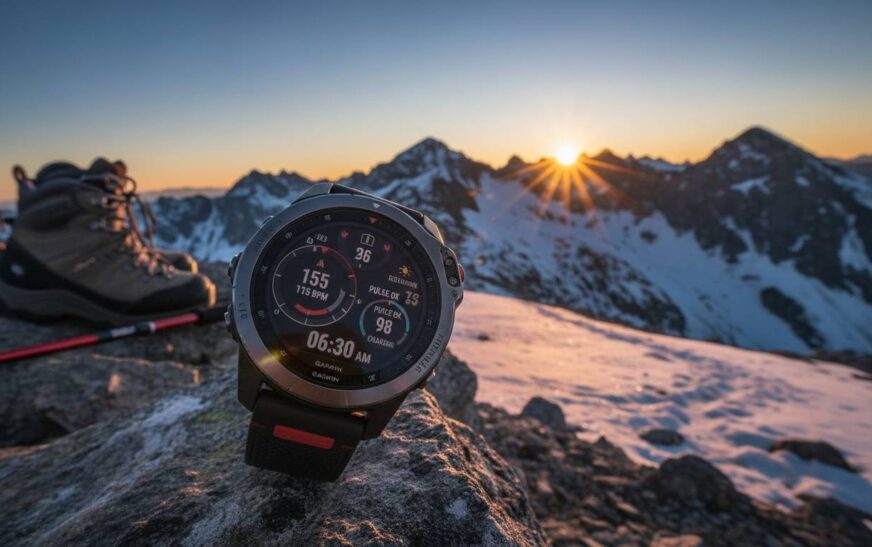
Finding the right smartwatch can feel overwhelming—especially when you want something that actually improves your workouts rather than just looking good on your wrist. After testing dozens of options across different price ranges, I’ve narrowed down the best fitness smartwatches for men in 2024. Whether you’re training for a marathon, lifting weights, or just want to track daily activity, these watches deliver accurate metrics, solid battery life, and features that genuinely help you reach your goals.
Quick Comparison Table
| Smartwatch | Price | Battery Life | Water Resistance | GPS | Heart Rate |
|---|---|---|---|---|---|
| Apple Watch Series 9 | $399 | 18 hours | 50m | Yes | Yes |
| Garmin Forerunner 265 | $499 | 7 days | 5 ATM | Yes | Yes |
| Garmin Fenix 7 Pro | $799 | 11-22 days | 10 ATM | Yes | Yes |
| Samsung Galaxy Watch 6 | $329 | 40 hours | IP68 | Yes | Yes |
| Whoop 4.0 | $239 | 5 days | IP68 | No | Yes |
| Fitbit Sense 2 | $249 | 6+ days | 5 ATM | Yes | Yes |
| Apple Watch Ultra 2 | $799 | 36 hours | 100m | Yes | Yes |
| Coros Pace 3 | $299 | 15 days | 5 ATM | Yes | Yes |
| Amazfit GTR 4 | $199 | 14 days | 5 ATM | Yes | Yes |
| Garmin Venu 3 | $449 | 14 days | 5 ATM | Yes | Yes |
Why Fitness Smartwatches Matter for Men
Let’s be honest—most of us don’t need another gadget collecting dust. But a good fitness smartwatch does something different: it holds you accountable. It shows you that “walk to the mailbox” doesn’t count as exercise. It pushes you to beat yesterday’s numbers.
The best fitness watches give you data you can actually use. Not just step counts, but recovery scores, training readiness, sleep quality, and workout-specific metrics that help you train smarter, not just harder.
Apple Watch Series 9 – Best Overall
The Apple Watch Series 9 isn’t just the most popular smartwatch—it’s also one of the most capable fitness trackers available. Apple’s latest iteration brings the S9 chip, which enables on-device Siri processing and a brighter display.
Key Features:
- New S9 chip with 60% more transistors
- Double tap gesture for one-handed control
- 18-hour battery (36 in Low Power Mode)
- Advanced health sensors including blood oxygen and ECG
- Precise GPS tracking
The fitness features here are solid. You get workout detection for common exercises, automatic pause for stoplights during runs, and detailed post-workout summaries. The Activity rings system, while simple, genuinely motivates many users to close their circles daily.
One thing to note: battery life is still Apple’s weakness. You’ll charge daily with moderate use. But if you’re already in the Apple ecosystem, the seamless integration with iPhone, AirPods, and health apps makes this a natural choice.
Pros:
- Excellent app ecosystem
- Precise GPS and heart rate tracking
- Bright always-on display
- ECG and blood oxygen monitoring
Cons:
- Daily charging required
- Limited to iOS only
- Expensive accessories
Garmin Forerunner 265 – Best for Runners
If running is your thing, the Garmin Forerunner 265 should be at the top of your list. This watch was designed specifically for runners and delivers an exceptional experience at a reasonable price point.
The 265 introduces a vibrant AMOLED display to the Forerunner line—a significant upgrade from the older LCD screens. Battery life is solid: up to 7 days in smartwatch mode and about 22 hours with GPS enabled.
What sets Garmin apart is their training ecosystem. You get access to Garmin Coach for personalized training plans, daily suggested workouts based on your training load, and recovery recommendations. The wrist-based heart rate works well for most activities, though chest straps remain more precise for high-intensity interval training.
Pros:
- Excellent running-specific features
- AMOLED display looks great
- Strong battery life
- Training readiness and recovery tracking
Cons:
- Bulkier case than some competitors
- Limited smart features outside fitness
Garmin Fenix 7 Pro – Best Premium Multisport
The Garmin Fenix 7 Pro is the no-compromise choice for serious athletes. This is a watch built for people who compete in triathlons, ultramarathons, or just take their fitness extremely seriously.
The build quality is excellent—titanium bezel, sapphire crystal glass, and 10ATM water resistance mean this watch can handle almost anything. Battery life is impressive: up to 22 days in smartwatch mode, 28 hours with GPS, and over 80 hours in max battery mode.
Inside, you get Garmin’s best sensors including multi-band GPS for pinpoint accuracy, optical heart rate, pulse ox, and barometric altimeter. The training features are comprehensive—VO2 max, training readiness score, heat and altitude acclimation, and full sport profiles for basically any activity you can imagine.
Pros:
- Excellent battery life
- Premium build quality
- Most advanced training metrics
- Multi-band GPS
Cons:
- Expensive ($799)
- Heavy on the wrist
- Overkill for casual users
Samsung Galaxy Watch 6 – Best Android Alternative
For Android users, the Samsung Galaxy Watch 6 delivers the best overall experience. It tracks sleep, exercise, and health metrics with impressive accuracy, all wrapped in a stylish design that looks good in the office or gym.
The rotating bezel is back, making navigation intuitive. Samsung’s Health app provides detailed insights, and the watch automatically detects workouts like running, cycling, and elliptical training. Sleep tracking has improved significantly, now including sleep stages and blood oxygen monitoring during rest.
Battery life runs about 40 hours with typical use—similar to Apple Watch, so expect daily charging. The watch pairs best with Samsung phones but works reasonably well with other Android devices.
Pros:
- Best Android integration
- Stylish design
- Good health tracking
- Rotating bezel navigation
Cons:
- Daily charging needed
- Best features reserved for Samsung phones
Whoop 4.0 – Best for Recovery Tracking
The Whoop 4.0 takes a different approach. Rather than being a traditional smartwatch with fitness features, it’s a fitness tracker that happens to be a smartwatch. The focus here is entirely on training load, recovery, and strain.
What makes Whoop unique is the Strain Coach feature—it tells you how hard to push each day based on your recovery status. The wristband is small and unobtrusive, with a battery that lasts about 5 days. No display means you check stats on your phone.
The subscription model ($239 for the band, then $30/month or $240/year) is polarizing. But for serious athletes who want data-driven training guidance, Whoop provides genuine value.
Pros:
- Excellent recovery and strain tracking
- Comfortable, low-profile design
- Accurate heart rate monitoring
- Sleep tracking
Cons:
- Subscription required
- No display
- Limited for casual users
Fitbit Sense 2 – Best Health-Focused
The Fitbit Sense 2 emphasizes holistic health tracking over raw sports features. If you care about stress management, sleep quality, and overall wellness, this watch delivers.
It includes cEDA (continuous electrodermal activity) for stress tracking, a body readiness score, and the most comprehensive sleep tracking in its price range. The Always-On display is bright and readable, and battery life reaches about 6 days—far better than Apple or Samsung.
For exercise, you get automatic workout detection, GPS tracking via your phone, and 40+ exercise modes. It’s not as detailed as Garmin for serious athletes, but it’s perfect for someone who wants fitness tracking without complexity.
Pros:
- Excellent sleep and stress tracking
- Week-long battery life
- Affordable price
- User-friendly interface
Cons:
- No native GPS (needs phone)
- Limited sports profiles compared to Garmin
Apple Watch Ultra 2 – Best for Adventure
The Apple Watch Ultra 2 is Apple’s most rugged and capable watch. Designed for extreme sports and adventurers, it features 100m water resistance, a titanium case, and the brightest display Apple has ever made.
Battery life improved significantly over standard Apple Watch—you get about 36 hours normally, or up to 72 hours in Low Power Mode. The Precision GPS is the most accurate Apple has offered, and the dual speakers are surprisingly loud.
This is the Apple Watch to get if you do triathlons, trail running, or any activity where you need maximum durability. It’s overkill for casual gym-goers, but for the right person, it’s fantastic.
Pros:
- Incredible durability
- Excellent GPS accuracy
- Long battery life for Apple
- Loud speakers
Cons:
- Expensive
- Large and heavy
- Still needs daily charging eventually
Coros Pace 3 – Best Value
The Coros Pace 3 flies under the radar but deserves attention. It’s one of the best value fitness watches you can buy, offering most of what Garmin provides at a lower price.
Battery life is strong—about 15 days in smartwatch mode and 32 hours with GPS. The watch is lightweight and comfortable, with a bright LCD display that’s easy to read outdoors. You get most key Garmin features: training load, recovery time, VO2 max, and comprehensive sport profiles.
The trade-off is a less polished app experience and fewer smart features. But if your focus is fitness over everything else, the Pace 3 delivers tremendous value.
Pros:
- Excellent value for money
- Outstanding battery life
- Lightweight and comfortable
- Robust fitness features
Cons:
- Basic smart features
- Less refined app experience
Amazfit GTR 4 – Best Budget Option
The Amazfit GTR 4 proves you don’t need to spend $400+ for a capable fitness watch. At around $199, it delivers impressive features including dual-band GPS, 14-day battery life, and comprehensive health tracking.
The design is classic and refined—a round watch face with sapphire glass and aluminum bezel that looks more expensive than it is. You get 14+ days of battery, automatic workout detection, and Zepp app integration that provides decent analytics.
It’s not as accurate as Garmin or Apple for heart rate, and the software feels less polished. But for the price, the GTR 4 is an excellent entry point.
Pros:
- Very affordable
- Excellent battery life
- Attractive design
- Good basic tracking
Cons:
- Less accurate heart rate
- App experience not as refined
Garmin Venu 3 – Best All-Rounder
The Garmin Venu 3 strikes a balance between fitness focus and everyday usability. It’s not as specialized as the Forerunner or Fenix lines, but it does everything well.
You get a bright AMOLED display, about 14 days of battery life, and full Garmin training features including Body Battery, training readiness, and sleep tracking. The Venu 3 also includes some smart features like reply notifications and music storage.
It’s slightly more expensive than competitors at similar spec levels, but the balance of features makes it a solid choice for someone who wants fitness tracking without sacrificing everyday usability.
Pros:
- Beautiful AMOLED display
- Good battery life
- Comprehensive fitness features
- Decent smart features
Cons:
- Premium pricing
- Not as specialized as Forerunner
How to Choose the Right Fitness Smartwatch
Consider Your Primary Activity
Not all fitness watches are created equal. If you’re a runner, the Forerunner 265’s running-specific features matter. If you swim, water resistance ratings and pool tracking become crucial. Think about your main workout and choose accordingly.
Battery Life vs. Features
There’s often a trade-off between features and battery. Apple and Samsung offer more smart features but need daily charging. Garmin and Coros offer week-long battery but fewer apps. Decide what’s more important to you.
Ecosystem Matters
Your phone matters. Apple Watch only works with iPhone. Samsung works best with Samsung phones. Garmin and Whoop work with both. Make sure your watch plays nice with your phone.
Budget Realistically
You don’t need to spend $800. The Coros Pace 3 at $299 or Amazfit GTR 4 at $199 offer 80% of what premium models provide. Spend more only if you need advanced features.
Frequently Asked Questions
Which smartwatch has the most accurate heart rate?
Garmin watches generally offer the most accurate optical heart rate monitoring, particularly the Fenix and Forerunner lines. For highest accuracy during high-intensity workouts, pair any of these with a chest strap heart rate monitor.
How long should a fitness smartwatch battery last?
It varies significantly by brand. Apple and Samsung need daily charging. Garmin and Coros typically last 7-14 days. Budget options like Amazfit can hit 14+ days. Consider how often you want to charge when choosing.
Are fitness smartwatches worth the money?
For active men who want data to improve their training, yes—absolutely. The accountability and insights from a quality fitness watch genuinely help. For casual users who just want notifications, a basic band or the fitness features on a standard watch may suffice.
What features should I look for in a fitness smartwatch?
Prioritize GPS accuracy, heart rate reliability, battery life, and the training ecosystem (recovery tracking, training load). Water resistance matters if you swim. Also consider comfort and how the watch looks as an everyday accessory.
Is the Apple Watch good for serious fitness?
The Apple Watch Series 9 and Ultra 2 are excellent for fitness, particularly for users already in the Apple ecosystem. However, serious athletes often prefer Garmin for more detailed training metrics and longer battery life.
Do I need cellular on my smartwatch?
Cellular is useful if you want to leave your phone behind during workouts or runs. Otherwise, the Bluetooth connection to your phone works fine and saves battery.
Conclusion
After testing across this range, the Apple Watch Series 9 remains the best overall choice for most men—combining excellent fitness tracking with everyday usability. But if you’re serious about running, the Garmin Forerunner 265 offers unmatched value. Adventurers should look at the Garmin Fenix 7 Pro, while budget-conscious buyers will love the Coros Pace 3.
The right watch is the one you’ll actually wear. Don’t get distracted by features you’ll never use. Pick based on your primary activity, your budget, and your ecosystem. Your future fitter self will thank you.