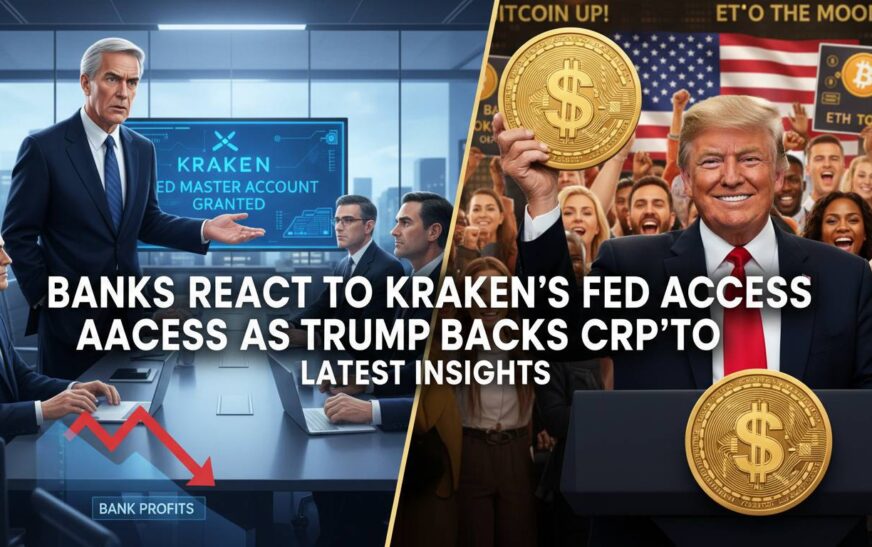

Kraken Financial, the Wyoming-chartered banking arm of cryptocurrency exchange Kraken, has become the first digital asset firm to gain direct access to the Federal Reserve’s core payment systems. This landmark development comes as former President Donald Trump continues to champion crypto-friendly policies, reshaping the financial landscape and prompting strong reactions from traditional banks.
A Historic Milestone in Crypto Integration
On March 4, 2026, the Federal Reserve Bank of Kansas City approved a limited-purpose master account for Kraken Financial, granting direct access to Fedwire and other core U.S. payment rails . This makes Kraken the first crypto-native institution to bypass intermediary banks and settle U.S. dollar transactions directly through the Federal Reserve .
The account comes with restrictions: Kraken will not earn interest on reserves held at the Fed, nor will it access emergency lending facilities—benefits typically available to traditional banks . The approval is structured as a one-year pilot under the Fed’s evolving “skinny” or limited-purpose master account framework .
Traditional Banks Push Back
Major banking trade groups swiftly voiced concern. The Bank Policy Institute criticized the approval, citing a lack of transparency and the absence of a finalized policy framework for such accounts . Independent Community Bankers of America echoed these concerns, warning that granting crypto firms access to master accounts could pose systemic risks to the banking system .
These institutions argue that crypto firms, unlike traditional banks, may not meet the same regulatory and risk management standards, raising questions about financial stability .
Trump’s Crypto-Friendly Stance
The approval aligns with a broader shift in U.S. policy under the Trump administration, which has embraced digital assets. In 2025, Trump signed Executive Order 14178, establishing a federal framework for digital assets and prohibiting a central bank digital currency . He also created a U.S. government Bitcoin reserve, treating seized crypto as a long-term store of value .
At the Blockworks Digital Assets Summit, Trump declared his ambition to make the U.S. the “undisputed Bitcoin superpower and the crypto capital of the world,” signaling a clear policy direction favoring crypto innovation .
Significance for Stakeholders
Kraken and the Crypto Industry
According to Arjun Sethi, Co‑CEO of Payward and Kraken, the Fed account marks the convergence of crypto infrastructure with sovereign financial rails, enabling Kraken to operate as a directly connected financial institution . The approval follows more than five years of regulatory engagement and operational scrutiny .
This access promises faster, more efficient fiat settlement for institutional clients, reduced reliance on correspondent banks, and potential for future innovations like atomic settlement between fiat and crypto .
Traditional Banks
Banking groups remain wary. They argue that crypto firms accessing central bank infrastructure without full regulatory parity could undermine financial stability . The lack of transparency in the approval process further fuels concerns .
Regulators and Policymakers
The Kansas City Fed emphasized that the decision was based on a risk-based assessment under the Fed’s External Link Account Access Guidelines, with tailored limitations appropriate to Kraken’s business model . Fed Governor Christopher Waller has indicated that the broader “skinny master account” framework may be finalized later this year .
Broader Implications and Future Outlook
This development signals a potential turning point in the integration of digital assets into mainstream finance. If successful, Kraken’s pilot could pave the way for other crypto firms—such as Custodia, Ripple, or Circle—to seek similar access .
However, the move also raises critical questions about regulatory parity, risk management, and the balance between innovation and stability. Banks and regulators will closely monitor the pilot’s outcomes to determine whether broader adoption is warranted.
Conclusion
Kraken’s access to the Federal Reserve’s payment system represents a historic milestone in the convergence of crypto and traditional finance. While the Trump administration’s crypto-friendly policies have facilitated this breakthrough, traditional banks remain cautious, citing concerns over transparency and systemic risk. As the pilot unfolds, its success—or failure—will shape the future of digital asset integration into the U.S. financial system.
Frequently Asked Questions
What exactly did Kraken gain from the Federal Reserve?
Kraken Financial received a limited-purpose master account from the Federal Reserve Bank of Kansas City, granting direct access to Fedwire and core U.S. payment systems. The account excludes interest on reserves and emergency lending facilities .
Why are banks concerned about this development?
Banking groups argue that crypto firms accessing Fed infrastructure without full regulatory safeguards could pose risks to financial stability. They also criticized the lack of transparency in the approval process .
How does this align with Trump’s crypto policies?
The approval aligns with Trump’s broader pro-crypto stance, including executive orders establishing a digital asset framework and a government Bitcoin reserve, as well as his vision of the U.S. becoming a global crypto leader .
What are the limitations of Kraken’s Fed account?
Kraken’s account is limited in scope: it does not include interest on reserves or access to emergency lending. It is structured as a one-year pilot under the Fed’s “skinny master account” framework .
Could other crypto firms gain similar access?
Yes. Kraken’s approval may serve as a precedent for other crypto-native firms like Custodia, Ripple, or Circle to pursue similar access, depending on regulatory developments and the pilot’s success .
What’s next for this initiative?
The Federal Reserve may finalize its “skinny master account” framework later this year. Regulators and industry stakeholders will monitor Kraken’s pilot closely to assess its impact on financial stability and infrastructure integration .