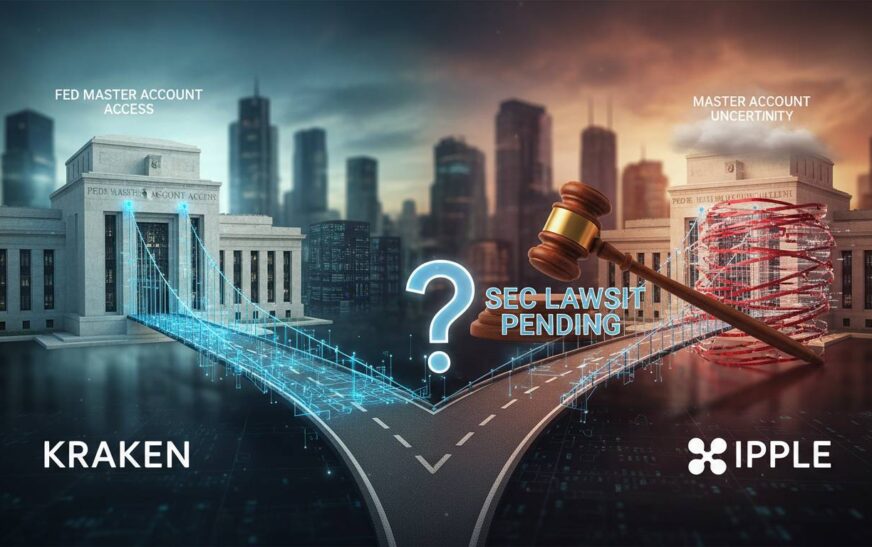


Kraken Financial, the Wyoming-chartered banking arm of Kraken, has become the first crypto-focused institution to secure a Federal Reserve master account. This milestone raises the question: could Ripple follow suit with its own master account? This article explores the implications of Kraken’s breakthrough, examines Ripple’s current regulatory path, and considers what lies ahead for crypto firms seeking direct access to the U.S. central bank’s payment infrastructure.
Historic Milestone: Kraken Gains Fed Access
On March 4, 2026, Kraken Financial was granted a limited-purpose Federal Reserve master account by the Federal Reserve Bank of Kansas City, marking the first time a digital asset-focused institution gained direct access to the Fed’s payment infrastructure . The approval allows Kraken to connect directly to core U.S. payment rails, including Fedwire, eliminating reliance on intermediary correspondent banks .
This access, however, comes with restrictions. Kraken cannot earn interest on reserves held at the Fed, access emergency lending facilities, or use the discount window . The account is classified under the Fed’s Tier 3 framework, reserved for institutions without federal deposit insurance or federal supervision, and is subject to heightened scrutiny . The approval is for an initial one-year period, with services to be rolled out gradually .
Arjun Sethi, Co‑CEO of Payward and Kraken, described the development as a convergence of crypto infrastructure and sovereign financial rails, enabling Kraken to operate as a directly connected financial institution rather than a peripheral participant .
Significance for the Crypto Industry
Kraken’s access to the Fed’s payment system is a landmark moment for the crypto industry. It signals a shift in regulatory openness and demonstrates that crypto-native firms can meet the standards required for integration into traditional financial infrastructure .
This development may set a precedent for other crypto firms, potentially accelerating regulatory acceptance and infrastructure integration. However, the limited nature of the access underscores that full parity with traditional banks remains out of reach—for now .
Ripple’s Path: Could It Follow?
Current Status
Ripple, through its acquisition of Standard Custody & Trust Company in June 2024, has positioned itself within the regulated financial framework . In July 2025, Ripple applied for a U.S. national bank charter and submitted a request for a Federal Reserve master account via Standard Custody .
Regulatory Hurdles
Caitlin Long, CEO of Custodia Bank, emphasized that trust-chartered entities like Ripple are not legally eligible for direct Fed payment system access unless they become depository institutions. Trust companies are prohibited from accepting U.S. dollar deposits, a key requirement for Fedwire and ACH access .
The Fed’s Account Access Guidelines reinforce this distinction, subjecting non-insured, novel charters to the most stringent review. Courts have upheld the Fed’s discretion to deny access even to eligible institutions .
Indirect Access via FedNow
Ripple currently leverages indirect access to Federal Reserve payment infrastructure through its partnership with Finastra, which is integrated with the FedNow Service. This setup allows Ripple to route real-time payments via Finastra’s system, enabling settlement in central bank money without violating regulatory restrictions .
Future Prospects
Ripple’s pursuit of a national bank charter and master account application indicates its ambition to secure direct Fed access. If approved, this would bring RLUSD reserves and settlement closer to the Fed’s balance sheet, enhancing trust and security in its stablecoin infrastructure .
However, Ripple must overcome legal and regulatory barriers that currently favor depository institutions. Its success may hinge on whether regulators are willing to extend access to crypto-native firms under a bank charter framework.
Implications and Outlook
Kraken’s breakthrough may pave the way for other crypto firms, but each case will be evaluated individually. Ripple’s path is more complex due to its trust charter status and the need for a national bank charter.
If Ripple succeeds, it could:
- Enhance the credibility and stability of RLUSD.
- Set a precedent for stablecoin issuers seeking central bank integration.
- Drive broader institutional adoption of crypto-native financial infrastructure.
However, if denied, Ripple may continue relying on indirect access via FedNow and Finastra, maintaining a regulatory-compliant but limited role in U.S. payment systems.
Conclusion
Kraken Financial’s acquisition of a Federal Reserve master account marks a historic milestone for the crypto industry. It demonstrates that regulated, crypto-native institutions can gain direct access to central bank infrastructure—albeit under strict limitations.
Ripple’s pursuit of a similar path is underway, but its success depends on navigating regulatory distinctions between trust companies and depository institutions. Whether Ripple can follow Kraken’s lead remains uncertain, but the outcome will significantly influence the future of crypto integration into mainstream finance.
Frequently Asked Questions
What exactly did Kraken gain with its Fed master account?
Kraken Financial received a limited-purpose Federal Reserve master account, granting direct access to payment rails like Fedwire. It cannot earn interest on reserves or access emergency lending facilities .
Why can’t Ripple get a Fed master account yet?
Ripple operates under a trust charter, which legally prohibits it from accepting U.S. dollar deposits. The Fed requires depository institution status for direct payment system access .
How is Ripple currently accessing Fed payment infrastructure?
Ripple uses indirect access via its partnership with Finastra, which connects to the FedNow Service. This allows real-time settlement in central bank money without direct Fed access .
What would Ripple need to do to gain direct Fed access?
Ripple must obtain a U.S. national bank charter and pass the Fed’s risk-based review for master account eligibility. If successful, it could integrate RLUSD reserves and settlement directly with the Fed .
Does Kraken’s approval mean other crypto firms will get Fed access?
Not necessarily. Each application is evaluated individually. Kraken’s approval may signal regulatory openness, but other firms must meet stringent criteria and face case-by-case scrutiny .
What are the broader implications for the crypto industry?
Kraken’s milestone could accelerate institutional adoption and regulatory integration of crypto infrastructure. Ripple’s potential success would further legitimize stablecoin ecosystems and strengthen the bridge between digital assets and traditional finance.
The post Kraken Gains Fed Access: Could Ripple Secure Its Own Master Account? appeared first on Crunchtime News.