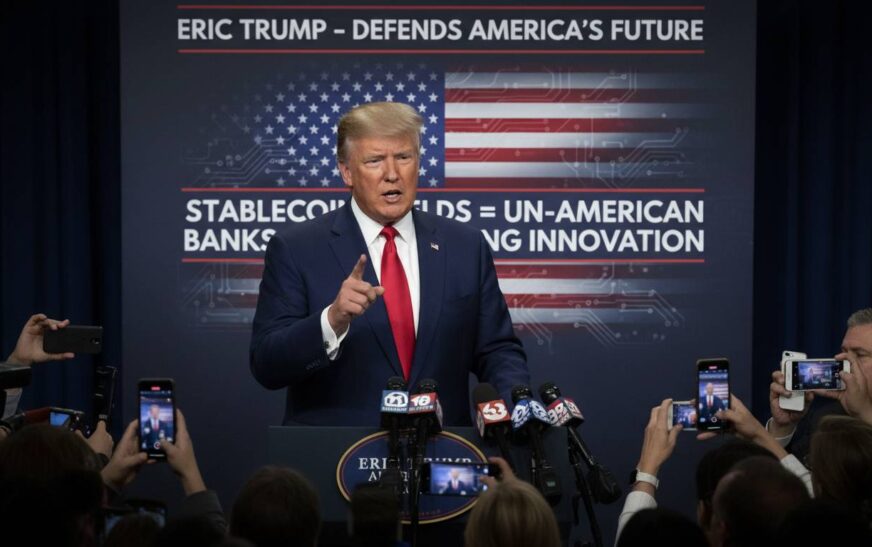

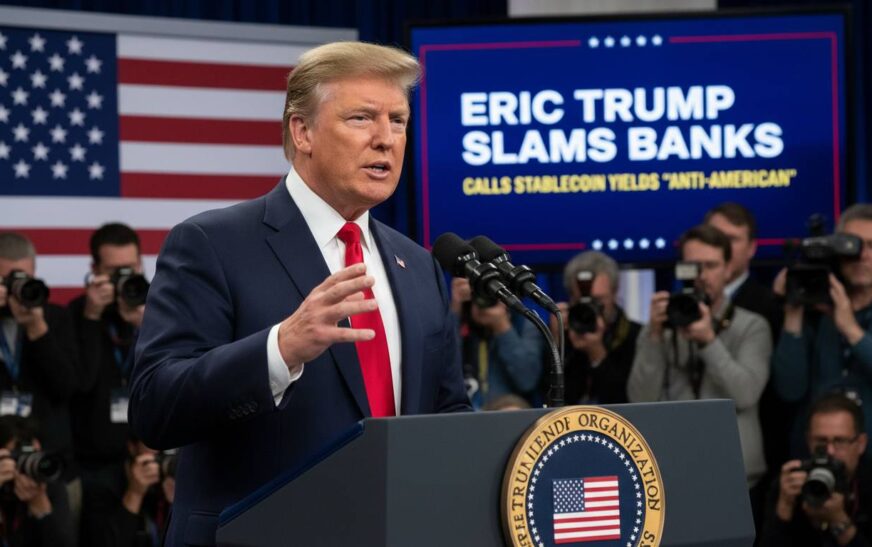
Eric Trump, co‑founder of World Liberty Financial (WLFI), has sharply criticized major U.S. banks for opposing stablecoin yields, labeling their actions “anti‑American.” His remarks come amid a heated debate over the future of crypto regulation and the stalled CLARITY Act, which seeks to define how digital assets should be regulated.
Banks Accused of Protecting a “Low‑Rate Monopoly”
In a post on X (formerly Twitter) on March 4, 2026, Eric Trump targeted institutions like JPMorgan Chase, Bank of America, and Wells Fargo, accusing them of lobbying to block Americans from earning higher returns on their savings. He highlighted the disparity between the Federal Reserve’s interest rates—over 4%—and the near-zero rates (0.01%–0.05%) offered by banks on standard savings accounts .
Trump argued that banks are using legislative influence to maintain their profit margins, preventing stablecoin platforms from offering yields of 4%–5% or more. He called this behavior “anti‑retail, anti‑consumer, and straight‑up anti‑American” .
Legislative Battleground: CLARITY Act and GENIUS Act
The CLARITY Act, a crypto market structure bill, has become a focal point in this dispute. Trump and others claim that banking lobbyists, including the American Bankers Association, are spending millions to restrict stablecoin yield provisions in the legislation . The bill passed the House in July 2025 but stalled in the Senate, missing a March 1 compromise deadline .
Meanwhile, the GENIUS Act, signed into law in July 2025, established a regulatory framework for stablecoins, requiring them to be backed one-to-one by U.S. dollars or low-risk assets . However, both the GENIUS Act and similar legislation explicitly prohibit yield-bearing stablecoins by regulated issuers .
Risks and Industry Pushback
Banking leaders warn that allowing yield-bearing stablecoins could trigger massive deposit outflows. Bank of America CEO Brian Moynihan cited estimates that up to $6 trillion could shift from traditional bank deposits to stablecoins, potentially undermining banks’ lending capacity . The Treasury Department has echoed these concerns, warning of systemic risk .
The crypto industry counters that such warnings are exaggerated and serve to stifle competition. They argue that yield-bearing stablecoins would pressure banks to offer better rates to consumers who have seen minimal returns for over a decade .
World Liberty Financial’s Stake in the Debate
Eric Trump’s criticism is closely tied to his financial interests. WLFI issues the USD1 stablecoin, which offers competitive yields and is backed by U.S. Treasuries and cash equivalents . A regulatory environment that permits yield-bearing stablecoins would directly benefit USD1’s market appeal, while restrictions would limit its competitiveness .
WLFI has also pursued a national banking license through its affiliate, World Liberty Trust, which would allow it to issue and safeguard USD1 . The company has already engaged in international partnerships, including a deal with Pakistan to explore using USD1 for cross-border payments .
Broader Implications and Industry Perspectives
This clash highlights a broader tension between traditional finance and emerging crypto models. Banks emphasize consumer protection and financial stability, citing the lack of FDIC insurance for stablecoins and potential risks to lending markets . Crypto advocates, including Eric Trump, argue that innovation and competition are being stifled by entrenched interests.
NYU fintech consultant Austin Campbell described the banking industry as being in “panic mode” over yield-bearing stablecoins, accusing lawmakers of protecting a cartel at the expense of voters . Meanwhile, the White House has signaled that banks need not fear stablecoin yields, suggesting that regulated digital currencies can coexist with traditional banking .
Conclusion
Eric Trump’s condemnation of banks for opposing stablecoin yields underscores the growing friction between crypto innovation and traditional financial institutions. His “anti‑American” label reflects both ideological conviction and vested interest in the outcome of crypto regulation. As the CLARITY Act remains unresolved and the GENIUS Act prohibits yield-bearing stablecoins, the future of digital asset regulation hangs in the balance. The debate raises critical questions about consumer choice, financial stability, and the evolving role of banks in a digital economy.
Frequently Asked Questions
What did Eric Trump say about banks and stablecoin yields?
He accused major banks of lobbying to block Americans from earning higher yields on their savings via stablecoins, calling their actions “anti‑American” .
What is the CLARITY Act?
The CLARITY Act is a pending crypto market structure bill aimed at defining regulatory oversight for digital assets. It has stalled in the Senate amid disputes over stablecoin yield provisions .
What does the GENIUS Act do?
Signed into law in July 2025, the GENIUS Act establishes a regulatory framework for stablecoins, requiring them to be backed by U.S. dollars or low-risk assets. It prohibits yield-bearing stablecoins by regulated issuers .
Why are banks opposed to yield-bearing stablecoins?
Banks warn that such stablecoins could trigger massive deposit outflows—potentially up to $6 trillion—undermining their lending capacity and financial stability .
What is World Liberty Financial’s role in this?
WLFI issues the USD1 stablecoin, which offers competitive yields and is backed by U.S. Treasuries. The company stands to benefit from regulations that allow yield-bearing stablecoins .
How do crypto advocates respond to banks’ concerns?
They argue that warnings about stablecoin risks are exaggerated and serve to protect banks’ low-rate monopolies. They believe yield-bearing stablecoins would foster competition and benefit consumers .