

China’s National People’s Congress (NPC) convened on March 5, 2026, unveiling a policy framework that signals a more stable yuan, reduced capital flight, and a strategic shift in digital asset regulation. This article explores how these developments—summarized by the phrase stable yuan, shrinking flight: what China’s NPC means for crypto—are poised to reshape the global cryptocurrency landscape.
Controlled Yuan Stability and Capital Flight Reduction
China’s NPC set a modest growth target of 4.5–5% for 2026, the lowest since 1991, yet the scale of economic activity remains immense. Even at the lower bound, China is projected to add approximately $900 billion in output this year—comparable to the GDP of countries like the Netherlands or Saudi Arabia . More critically, Beijing signaled a commitment to a stable yuan, aiming for gradual appreciation toward 6.70 against the dollar while avoiding sharp fluctuations . This controlled stability reduces the incentive for capital flight, historically a driver of Chinese retail demand for Bitcoin and dollar-pegged stablecoins .
Regulatory Clampdown on Yuan-Pegged Stablecoins
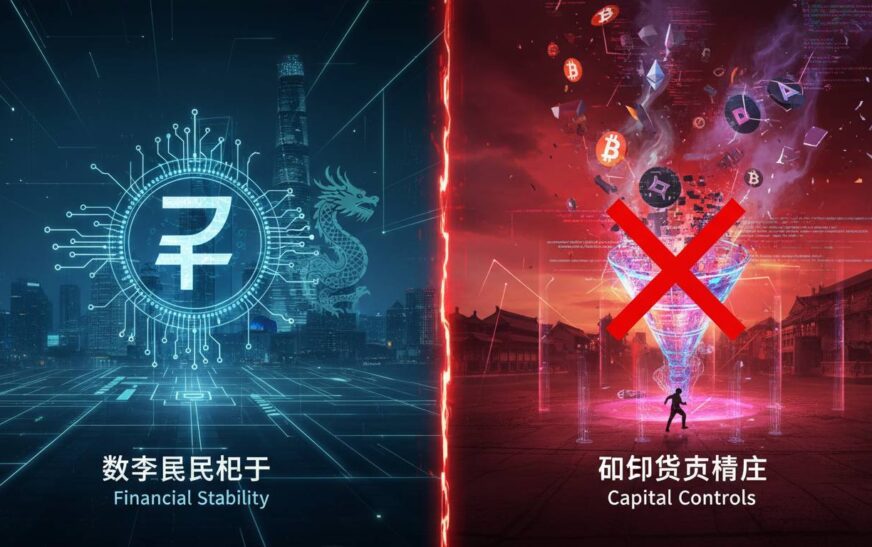
On February 6, 2026, China’s central bank and multiple regulatory bodies issued a sweeping notice banning the issuance of unapproved yuan-linked stablecoins—both domestically and overseas—effective immediately . The notice classifies virtual currencies, stablecoins, and tokenized real-world assets (RWA) as illegal financial activities unless explicitly approved . This marks the most aggressive crypto crackdown since the 2021 mining ban, extending enforcement to overseas operations of Chinese entities .
Strategic Emphasis on e‑CNY and Tokenization Under Control
China is promoting its central bank digital currency, the e‑CNY, as the regulated alternative to private stablecoins. Commercial banks began offering interest-bearing e‑CNY wallets in January 2026, reinforcing its appeal . The 15th Five-Year Plan, unveiled at the NPC, further emphasizes equity financing and RWA markets—but within tightly controlled, state-sanctioned frameworks . Analysts note that while RWA tokenization is not banned outright, it is subject to strict oversight and limited to approved channels .
Market Reaction: Flight to Quality and Liquidity Shifts
The regulatory crackdown triggered immediate market responses. Blockchain analytics firm Chainalysis reported that approximately $18.7 billion in RMB-backed digital assets were affected, and trading volumes for yuan trading pairs dropped by 73% within 48 hours . Market analysts observed a “flight to quality,” with investors reallocating capital toward projects with strong fundamentals and regulatory resilience .
Significance for Stakeholders
Domestic Investors and Firms
Chinese investors face diminished access to yuan-pegged stablecoins and must pivot toward the e‑CNY or offshore alternatives. Firms involved in tokenization or stablecoin issuance must navigate a narrow approval process or risk enforcement actions .
Global Crypto Markets
The crackdown reduces yuan-denominated liquidity in crypto markets, potentially shifting trading volumes to dollar-based stablecoins. It also underscores the geopolitical dimension of digital currencies, as China seeks to protect monetary sovereignty and limit U.S. dollar influence .
Regulatory Precedent
China’s approach—combining capital controls, CBDC promotion, and suppression of private stablecoins—may influence other nations’ regulatory strategies. The emphasis on state-controlled digital currency infrastructure contrasts sharply with more permissive frameworks emerging in parts of the West.
Analysis and Future Outlook
China’s NPC has reaffirmed a long-term strategy: maintain monetary sovereignty, curb speculative crypto activity, and channel digital innovation through state-sanctioned mechanisms. The phrase stable yuan, shrinking flight: what China’s NPC means for crypto encapsulates this dual strategy of economic stability and regulatory control.
Looking ahead:
- The e‑CNY is likely to gain broader adoption, especially in cross-border trade settlements and domestic transactions.
- Private stablecoin and RWA projects may shift focus to jurisdictions with clearer regulatory pathways.
- Global crypto markets may see continued fragmentation along geopolitical lines, with dollar-based stablecoins gaining further dominance.
Conclusion
China’s NPC has delivered a clear message: the era of private yuan-pegged stablecoins is over. A stable yuan, combined with aggressive regulation, is reshaping capital flows and digital asset markets. Investors and firms must adapt to a landscape where the e‑CNY and state-approved tokenization dominate. The implications are profound, extending beyond China to the global architecture of digital finance.
Frequently Asked Questions
What does “stable yuan, shrinking flight” mean?
It refers to China’s efforts to maintain a stable yuan exchange rate and reduce capital flight, which historically drove demand for crypto assets like Bitcoin and stablecoins.
Why did China ban yuan-pegged stablecoins?
Authorities view them as threats to monetary sovereignty, financial stability, and capital control. The ban aims to eliminate unregulated digital currency flows.
What is the e‑CNY and how does it fit into this strategy?
The e‑CNY is China’s central bank digital currency. It is state-controlled, integrates with financial infrastructure, and is being promoted as the only legal digital alternative to private stablecoins.
How have markets reacted to these changes?
Yuan trading pairs saw a 73% drop in volume within 48 hours of the ban. Investors are reallocating to projects with strong fundamentals and regulatory clarity.
What does this mean for global crypto markets?
It reinforces the dominance of dollar-based stablecoins and highlights the geopolitical divide in digital currency regulation.
Can private stablecoin projects still operate?
Only if they receive explicit approval from Chinese regulators. Most private issuance, especially offshore, is now prohibited.