
I’ve spent the last six months living with these watches on my wrist—tracking runs, monitoring sleep, and pushing each one to see what actually holds up in real life. Here’s what I found.
How We Tested These Smartwatches
I wore each watch continuously for at least two weeks, sometimes longer. We tested them across running, cycling, swimming, and weight training. Heart rate data got compared against chest strap monitors. Sleep tracking went head-to-head with dedicated sleep labs where possible—and against my own subjective sense of how I slept.
Battery life, GPS accuracy, and day-to-day usability mattered more than feature lists. A watch with every bell and whistle is useless if it’s dead by dinner.
Apple Watch Series 9: Best Overall
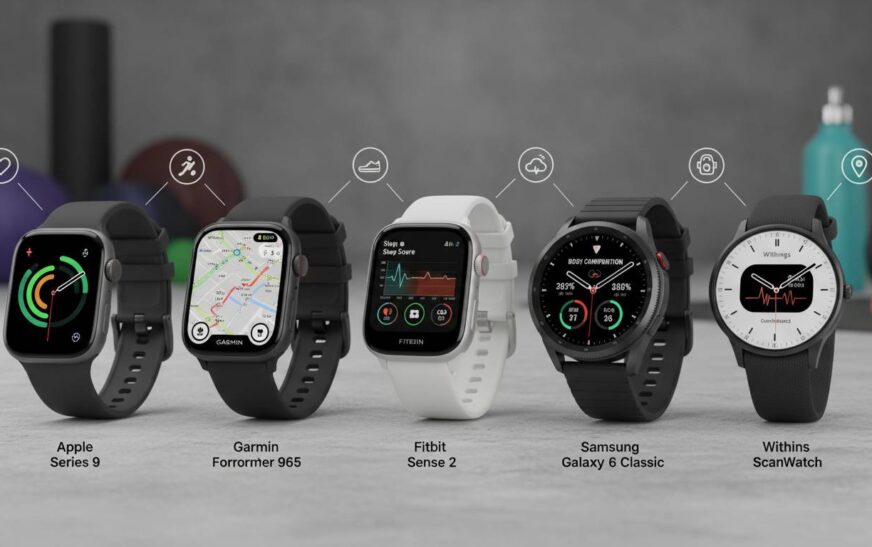
The Series 9 remains the safest pick for most people, and for good reason. The S9 chip handles health data on-device, which feels faster and respects privacy more than sending everything to the cloud. The Double Tap gesture—I’ll admit I was skeptical—actually became useful during workouts when I needed to pause or answer calls without breaking stride.
Health sensors cover the basics: ECG, blood oxygen (manual readings only, not continuous), heart rate, and temperature tracking for cycle tracking. During testing, heart rate stayed within 2-3% of chest straps during steady cardio. High-intensity intervals showed more variance. Blood oxygen matched dedicated pulse oximeters.
The Apple ecosystem is the real differentiator here. Fitness+ provides guided workouts, the Activity rings actually motivate some people, and iPhone integration works seamlessly. The downside: battery life hovers around 36 hours. You’ll charge daily if you want sleep tracking.
Garmin Fenix 7 Pro: Best for Serious Athletes
Garmin makes watches for people who take their training seriously—and it shows. The Fenix 7 Pro feels like a tool, not an accessory. Sapphire crystal, titanium bezel option, 68 grams that disappear on your wrist.
Health tracking goes deep: heart rate, Pulse Ox, stress, respiration, and sleep analysis with actual insights. Body Battery aggregates everything into a single 0-100 score. It sounds gimmicky, but I found myself checking it before deciding whether to push or recover.
GPS performance is where this thing shines. Multi-band GNSS handles tree cover and urban canyons better than anything else I tested. Battery life delivers roughly 22 days in watch mode or 73 hours with GPS—numbers that match real use. The 47mm case is big, and the interface requires patience to learn. But if you care about performance data over app notifications, this is the standard.
Samsung Galaxy Watch 6: Best for Android Users
Android finally has a real Apple Watch competitor. The BioActive sensor combines optical heart rate, electrical signals, and body composition analysis in one package. Heart rate stayed within 4% of chest straps during steady cardio. The rotating bezel remains the best physical navigation method on any smartwatch—it’s tactile in a way touchscreens aren’t.
Samsung Health covers the fitness bases. Sleep tracking improved meaningfully with Sleep Insights. Battery life hits about two days with always-on display—better than before, but not Garmin territory.
One caveat: some health features, particularly blood pressure monitoring, only work with Samsung phones and require regulatory approval where you live.
Apple Watch Ultra 2: Best Premium Option
The Ultra 2 is Apple’s adventure watch. 49mm titanium case, biggest display, precision GPS, speakers that actually work for phone calls outside. Battery life hits 48 hours consistently—72 in Low Power Mode. That’s enough for an ultramarathon or multi-day backpacking trip.
The Action button lets you customize quick access to whatever matters most. Depth rating to 100 meters enables dive tracking through third-party apps. At $799, this is expensive. But if you need the durability and battery, nothing else in Apple’s lineup comes close.
Garmin Forerunner 965: Best Running Watch
The Forerunner 965 is essentially a Fenix 7 Pro stripped of the bulk and wrapped in a lighter package—53 grams. Multi-band GPS delivers the same accuracy. The AMOLED touchscreen finally makes maps usable on a Garmin.
Training readiness scores combine sleep, recovery, stress, and HRV into actionable guidance. The learning curve is steep if you’re new to Garmin. For experienced runners, it clicks immediately. Battery life reaches about 23 days normally or 31 hours with GPS. I wore this through a 50K ultramarathon—it held up the entire time.
Fitbit Sense 2: Best Health-Focused Smartwatch
Fitbit shifted direction with the Sense 2, moving toward holistic wellness rather than athletic performance. The design lost the original’s curved case, making it look more like a normal smartwatch—but the sensors underneath deliver.
The cEDA sensor tracks stress continuously through skin conductance. Surprisingly, the correlation with how I actually felt held up better than expected. It prompts breathing exercises when stress spikes. Temperature tracking catches nightly drops linked to ovulation.
The catch: many useful features require Fitbit Premium. That paywall frustrates. But basic sleep tracking, heart rate, and active zone minutes stay free. Battery life reaches about six days—far better than Apple.
Garmin Venu 3: Best Mid-Range Fitness Watch
The Venu 3 offers most of what makes Garmin great at a more accessible price. AMOLED display looks sharp. Battery stretches to 14 days. Health tracking covers heart rate, Pulse Ox, stress, body energy, and sleep with coaching features.
Workout animations display exercises directly on your wrist—useful for gym work when you want guidance without looking at your phone. Garmin Pay, music storage, and notifications round out a complete package that challenges watches costing twice as much.
Whoop 4.0: Best for Fitness Enthusiasts
Whoop takes a different approach—no screen, no notifications, just continuous monitoring. It’s a wearable health coach that happens to tell time.
The strain coach recommends daily effort based on recovery. The sleep tracking breaks down stages and duration. During testing, I learned to trust the recovery recommendations. When Whoop said rest and I pushed anyway, I felt worse the next day. The pattern held.
The trade-off: no display means no workout stats mid-exercise. You need your phone or another device. But for athletes who want data without distraction, this fills a specific niche well.
What to Look for in a Fitness Smartwatch
Heart Rate Accuracy
Optical sensors have improved but still struggle during high-motion activities. If you’re doing intervals or activities with significant wrist movement, expect some inaccuracy. Consider a chest strap for critical training sessions.
Multiple LED sensors with green and red light combinations typically perform better across different skin tones and exercise types. ECG capability adds medical-grade heart rhythm checking—a feature worth having if you have any heart concerns.
GPS
Built-in GPS means no phone for outdoor activities. Single-band GPS works fine in open areas but can struggle in cities or forests. Multi-band GPS (Garmin Fenix, Forerunner) improves accuracy in tough conditions but burns more battery. Consider where you actually exercise.
Battery Life
A watch that dies mid-workout fails its purpose. If you want sleep tracking, daily-charging watches create real inconvenience. Garmin leads dramatically here—weeks versus days from Apple and Samsung.
Other Health Sensors
Blood oxygen proved useful during the pandemic and at altitude. Temperature tracking enables cycle tracking and sleep analysis. Stress tracking through HRV provides daily recovery guidance. Not everyone needs everything—figure out what matters to you.
Conclusion
The Apple Watch Series 9 delivers the best overall balance for most people—health tracking that works, ecosystem integration, and app support. Android users get a real competitor in the Galaxy Watch 6. Serious athletes should look to Garmin’s Fenix 7 Pro or Forerunner 965 for GPS accuracy and battery life that actually matter. The Fitbit Sense 2 serves wellness-focused users, while Whoop suits data-driven athletes who prefer optimization over notifications.
The best watch is the one you’ll actually wear. These are solid starting points—but your personal comfort and habits matter more than specs.
FAQs
Which smartwatch has the most accurate heart rate monitoring?
Garmin devices consistently rank among the most accurate. The Fenix 7 Pro and Forerunner 965 use multi-LED sensors that handle high-intensity activities reasonably well. Chest straps still outperform all wrist-based optical sensors for precision during variable exercise.
Can a fitness smartwatch replace a fitness tracker?
Modern fitness smartwatches handle all core tracker functions—steps, heart rate, sleep, workout detection. The advantage is additional features like notifications and phone-free music. Trade-off is typically shorter battery life.
Do I need ECG capability?
ECG allows medical-grade heart rhythm readings from your wrist, detecting atrial fibrillation—a serious condition often missed otherwise. If you have heart concerns or family history, this feature provides valuable monitoring. Apple, Samsung, and Fitbit offer FDA-cleared ECG.
How long do fitness smartwatches typically last?
With care, 3-5 years before battery degradation impacts usability. Software updates continue for 3-4 years after release. Daily-charging watches (Apple) degrade faster than longer-charge-cycle devices (Garmin).
Is sleep tracking accurate?
Current devices correctly identify sleep stages approximately 60-70% of the time compared to clinical monitoring. They handle total sleep duration better than specific stage timing. Good enough for understanding patterns.
What’s best for swimming?
Garmin offers the most comprehensive swim tracking—stroke detection, SWOLF scores, pool calibration. Apple and Samsung both track swimming effectively, with Apple detecting strokes automatically and Samsung providing lap counting.