
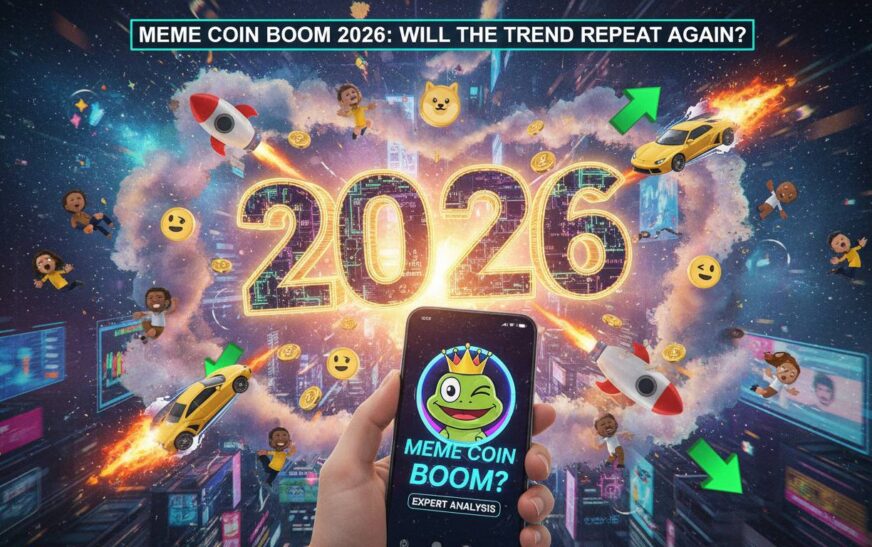
The crypto market in early 2026 is strange. Bitcoin and Ethereum have become boring institutional assets—the kind banks put in their portfolios, the kind pension funds theoretically consider. And yet, alongside this maturation, meme coins still command massive trading volume and capture attention like nothing else in the space.
Dogecoin keeps hanging around. PEPE and BONK have built legitimate communities. Despite every “meme coins are dead” headline written since 2021, the sector refuses to die. So the question everyone’s asking is simple: are we heading for another boom, or has the market finally grown up?
The Current State of Things
Meme coins have come a long way from the 2022 crash. Trading volume on decentralized exchanges remains strong, with meme tokens consistently representing a significant chunk of total activity. The top meme coins together sit somewhere between $40 billion and $80 billion in market cap—down from the peaks but far above the graveyard.
What feels different this time is how people are trading. Wallets hold multiple tokens instead of going all-in on one. We’ve seen meme coin index funds launch from DeFi platforms. None of this means institutional money is flooding in—but it’s no longer just degens throwing darts either.
Twitter still drives everything. Influencer accounts move prices in minutes. Telegram groups have exploded in size, with some channels hitting hundreds of thousands of members sharing “alpha” (read: speculation). This hasn’t changed since 2021.
Looking at Past Cycles
The first big wave hit in early 2021, right around the GameStop madness. Dogecoin went vertical—something like 15,000% in weeks. Elon Musk tweeted about it. Everyone lost their minds. The whole thing lasted about three months before it crashed hard.
That pattern was textbook: some triggering event catches mainstream attention, prices go up, more people notice, prices go up more. Feedback loop until it breaks.
The 2024-2025 cycle looked different. Instead of one token dominating, we got dozens of dog-themed and frog-themed tokens fighting for scraps. Launchpads made creating tokens trivial. This meant more opportunities but also way more scams and rug pulls. The barrier to entry dropped, but so did the average quality.
“The meme coin market has gotten more sophisticated in terms of community building and narrative management,” one analyst told me. “Whether that’s progress or just more polished gambling is honestly hard to say.”
The consistent thread across both cycles: narrative momentum is everything. These tokens have no earnings, no real utility most of the time—just social sentiment. When the story dies, the price crashes harder than almost anything else in crypto.
What Could Fuel a 2026 Boom
A few things could definitely move the needle.
Retail engagement hasn’t faded. Trading platforms aimed at regular people keep adding users. If crypto prices stay high generally, that retail energy has to go somewhere—and meme coins are the highest-upside outlet.
The infrastructure has improved. Blockchains have added faster finality, lower fees, and dedicated marketplaces for these tokens. Less friction means more trading.
Influencers still move markets. Musk and others have learned that a single tweet can create billions in market movement. The incentive to participate hasn’t gone away.
Macro conditions matter. Low interest rates and loose money tend to favor speculation. If the Fed pivots, that could be tailwind for everything risky.
And FOMO is real. The stories of $100 turning into $1 million keep circulating. They don’t have to be true—they just have to be visible.
What Could Kill the Boom
Plenty could go wrong too.
Regulation is the big one. The SEC and other agencies have been circling. They’ve already gone after several token issuers. One major enforcement action could crash the sector overnight. This isn’t hypothetical—it’s happened before.
Market saturation is brutal. There are thousands of meme coins now. Fragmentation means any single token struggles to grab attention. Most traders have been burned at least once, so trust is low. Launching a new token doesn’t carry the same novelty it did in 2021.
Investor fatigue is real. The novelty has worn off for a lot of people. Each cycle has produced smaller returns for more participants. The repeat players are getting harder to excite.
Technical disasters keep happening. Smart contract bugs, liquidity pool hacks—billions lost. As these tokens get more complex, the attack surface grows.
And if Bitcoin corrects hard, meme coins will get crushed first. Money flows to safety when the music stops.
Which Tokens Could Lead
If boom happens, some categories seem positioned.
Established names like Dogecoin and Shiba Inu have brand recognition that never fades. They’ve survived multiple crashes and still have active communities. Doge has actual payment integrations now. Shiba has built out a whole ecosystem. These aren’t just memes anymore—they’re brands.
Newer tokens with actual tokenomics could matter. Deflationary mechanisms, staking rewards, governance rights—stuff that gives holders a reason to stay beyond pure speculation. Several launched in 2024-2025 have built followings around these features.
Community-driven tokens that actually decentralize might attract people sick of developer rug pulls. The ones that prove genuine governance tend to keep communities through crashes.
Cross-chain tokens have advantages too. If you’re on multiple networks, you reach more traders. Interoperability keeps improving.
What Experts Are Saying
Analysts are all over the place.
Some see continued growth—retail demand is real, infrastructure keeps improving, the engagement hasn’t dropped off. They point to sustained volume as evidence the market wants this.
Others think it’s mostly a negative-sum game where sophisticated traders extract value from newcomers. From that view, any boom is just a chance to take money from people who showed up late.
Surveys show retail interest remains but caution has increased. People know it’s risky. Position sizes have stayed modest—not growing but not shrinking either.
Mainstream publications cover meme coins as barometer of retail sentiment, not legitimate investing. This creates visibility but reinforces the speculation angle.
What to Watch
For anyone paying attention:
DEX volume trends matter. Growing volume in smaller caps often precedes price moves. Rising prices with falling volume is a warning sign.
Social metrics—Twitter engagement, Telegram growth, Reddit activity—can predict narrative momentum. Fast-growing communities often precede pumps, though timing is unpredictable.
Regulatory news could change everything overnight. A major enforcement action would trigger selling. Clarity could actually help by weeding out scams.
Bitcoin’s direction remains key. In bull markets, speculation outperforms. In bear markets, capital flees to safety.
The honest answer on whether history repeats: nobody knows. Meme coins have survived predictions of their death repeatedly. But each cycle brings more scrutiny, more regulation, more sophistication. Eventually something gives.
What I can say for sure: meme coins will remain a weird corner of crypto—part lightning rod for excitement, part cautionary tale. Anyone getting involved should understand they’re playing a game where the house often wins and the line between opportunity and disaster only shows up in hindsight.