
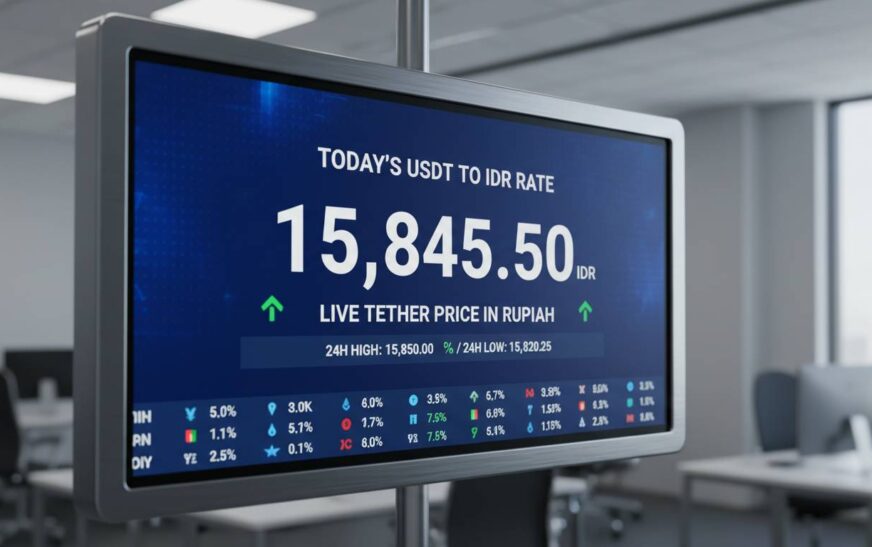
Indonesian cryptocurrency traders keep a close eye on the USDT to IDR exchange rate, which serves as the main pricing benchmark for digital asset transactions across the country. Currently, Tether (USDT) is trading near 16,500 IDR per token, maintaining its close correlation with the US dollar despite the rupiah’s usual forex fluctuations.
This rate matters because it’s the primary way Indonesian exchanges price almost every cryptocurrency trading pair. Whether you’re buying Bitcoin, trading altcoins, or calculating profits, the USDT to IDR rate factors into nearly every decision Indonesian crypto traders make. Indonesia has grown into one of Southeast Asia’s largest crypto markets by volume, and the USDT to rupiah pairing handles the bulk of the country’s digital asset settlements.
Current USDT to IDR Exchange Rate Overview
Today’s market shows USDT trading between approximately 16,450 and 16,550 IDR across major Indonesian exchanges. The spread reflects differences in liquidity and fee structures between platforms.
Indodax lists buy orders around 16,480 IDR and sell orders near 16,520 IDR during peak hours. Tokocrypto shows similar pricing with minimal deviation. These rates align closely with the global USDT to USD rate translated through the USD to IDR spot market, though local demand dynamics occasionally create brief disconnections that arbitrageurs quickly close.
The 24-hour trading range has stayed within about 2%, suggesting relatively stable conditions. Combined trading volume across the top five Indonesian exchanges regularly exceeds several hundred billion rupiah daily.
“Every altcoin trade, every Bitcoin purchase, and every profit calculation ultimately flows through this pairing,” said a senior trader at a Jakarta-based registered digital asset exchange, speaking on condition of anonymity.
Where to Exchange USDT in Indonesia
Indonesian traders have several registered cryptocurrency exchanges to choose from for USDT to IDR conversions, each with different fee structures, verification requirements, and liquidity levels.
Indodax remains the largest domestic exchange by trading volume, offering competitive rates with commission structures that decrease for high-volume traders. The platform supports both market and limit orders. Identity verification typically takes a few business days, though expedited processing is available. The interface includes full Indonesian language support.
Tokocrypto, operated by an Indonesian fintech group, provides another option with a focus on mobile用户体验. Integration with the broader financial services ecosystem offers convenience for users managing both crypto and traditional banking assets. Rates generally track closely with Indodax, though liquidity differences occasionally create small advantages.
International exchanges like Binance and Bybit also serve Indonesian users, though rupiah withdrawals typically require additional steps through peer-to-peer (P2P) trading or local bank transfers. Binance P2P has become popular among Indonesian traders, enabling direct transactions with payments through Bank Central Asia, Bank Mandiri, and BRI. P2P rates often beat official exchange listings, though counterparty risk increases compared to centralized platforms.
Understanding USDT and Its Role in Indonesian Crypto Markets
Tether is a stablecoin designed to maintain a 1:1 peg with the US dollar, with each token backed by equivalent reserves in cash or cash equivalents. This makes USDT useful in Indonesia, where the rupiah’s periodic volatility against the dollar creates challenges for traders wanting stable valuation for their crypto portfolios. Converting to USDT instead of directly to IDR lets traders preserve dollar-denominated value while waiting for better exchange conditions.
Three main factors drive USDT’s practical utility in the Indonesian market. First, the rupiah has limited availability as a trading pair on global exchanges, so Indonesian traders use USDT as an intermediary to access international crypto markets. Second, day traders can lock in profits or limit losses without repeatedly converting between crypto and fiat, reducing exposure to forex volatility on top of crypto price swings. Third, deep liquidity in USDT trading pairs across major exchanges means large orders execute without significant slippage.
Indonesian regulations require crypto exchanges to partner with registered payment gateways for fiat on-ramps and off-ramps. Bappebti oversees the exchange ecosystem, requiring platforms to maintain segregated customer accounts and comply with AML protocols including KYC verification.
Historical USDT to IDR Rate Analysis
Over the past twelve months, USDT to IDR has traded between approximately 15,200 and 17,800 IDR per token. Movements closely tracked both the USD to IDR relationship and broader crypto market sentiment. The lower bound coincided with rupiah strength during commodity price downturns, while the upper bounds reflected flight-to-safety flows into dollar assets during global uncertainties.
The 30-day moving average currently sits near the middle of this range, suggesting neither extreme overvaluation nor undervaluation. Technical analysts point to support around 16,200 IDR and resistance near 16,800 IDR. Volume data indicates significant price movements often occur during Indonesian market hours, particularly during overlap with Asian trading sessions.
Seasonal patterns also play a role. Indonesian crypto interest typically increases around year-end when bonus payments provide extra investment capital. This seasonal demand has historically correlated with modest rate appreciation, though the pattern has become less reliable as adoption spreads throughout the year.
Factors Influencing USDT to IDR Exchange Rates
Several interconnected factors drive USDT to IDR movements, requiring traders to monitor both crypto-specific and traditional forex dynamics.
The most fundamental influence is the USD to IDR spot rate, reflecting the underlying dollar value that USDT maintains through its peg. When the rupiah weakens against the dollar, USDT prices in IDR rise proportionally.
Bank Indonesia’s monetary policy significantly impacts rupiah valuations through interest rate decisions affecting capital flows. Higher relative interest rates attract foreign capital seeking yield, strengthening the rupiah and reducing USDT to IDR rates. Accommodative policy can trigger outflows, pressuring the rupiah and increasing USDT valuations.
Crypto market sentiment is another major driver, especially during significant Bitcoin or Ethereum price movements. During bullish phases, Indonesian traders convert rupiah into USDT to buy altcoins, increasing USDT demand and pushing rates higher. Bearish conditions reverse this flow.
On-chain metrics offer additional insights into USDT flows. Rising USDT reserves on Indonesian exchanges often precede increased trading activity, while declining balances may signal profit-taking and conversion to fiat.
Practical Guide to Converting USDT to IDR
For Indonesian traders converting USDT to rupiah, understanding available pathways enables optimized execution.
The most straightforward method uses registered domestic exchanges like Indodax or Tokocrypto, where users sell USDT directly against IDR pairs and withdraw to linked bank accounts. This offers regulated platform security with competitive rates, though bank withdrawals typically take several hours to two business days.
Peer-to-peer trading provides flexibility and potentially better rates. Binance P2P and LocalCryptos enable direct negotiations between buyers and sellers with escrow protection. Sellers specify desired rates and payment methods; buyers browse listings and initiate trades upon finding suitable matches. This requires more caution and verification effort, but rates 1-3% better than official listings are achievable.
Bank transfer considerations affect conversion efficiency. BCA and Bank Mandiri generally process crypto exchange withdrawals faster than some smaller banks that may impose additional verification requirements.
Fee structures deserve attention since accumulated costs impact returns, especially for frequent traders. Indonesian exchanges typically charge 0.1-0.3% per transaction with volume discounts. P2P transactions may have lower explicit fees but wider spreads. Bank transfer fees generally range from 5,000 to 25,000 IDR per transaction, so consolidating larger withdrawals reduces per-unit costs.
Frequently Asked Questions About USDT to IDR Exchange
What is the current USDT to IDR rate?
As of the latest session, USDT is trading at approximately 16,450 to 16,550 IDR across major Indonesian exchanges. Rates fluctuate continuously, and minor variations exist between platforms. Check your preferred exchange immediately before transacting for accurate pricing.
Is USDT to IDR rate the same as USD to IDR rate?
The USDT to IDR rate closely tracks USD to IDR because USDT maintains a 1:1 peg with the dollar. However, deviations occur due to crypto-specific supply and demand, trading fees, and liquidity conditions. These deviations become more pronounced during high crypto volatility before arbitrage restores alignment.
Which Indonesian exchange offers the best USDT to IDR rate?
No single exchange consistently offers the best rates. Indodax and Tokocrypto typically provide competitive rates with lower spreads during peak hours. For larger transactions, comparing rates across exchanges and considering P2P options may yield better terms, though convenience and security also matter.
How long does USDT to IDR conversion take?
Times vary by method. Centralized exchange sales execute instantly at market rates; limit orders wait for specified prices. Bank withdrawals typically require 1-2 business days. P2P transactions can complete within minutes once buyers confirm payment and release escrowed USDT.
Are USDT to IDR conversions taxed in Indonesia?
Indonesian tax regulations classify cryptocurrency transactions as taxable events. Capital gains may face income tax while trading activity incurs additional levies. Bappebti requires exchanges to report transactions to tax authorities, and individuals remain responsible for accurate reporting. Consulting a tax professional familiar with Indonesian crypto regulations provides the most reliable guidance.
Conclusion
The USDT to IDR rate is a fundamental metric for Indonesia’s crypto market, serving as the primary valuation anchor for digital asset trading across the country. Current rates near 16,500 IDR reflect relatively stable conditions, though traders watch both traditional forex dynamics and crypto-specific factors that could trigger movement.
Looking ahead, several catalysts could impact rates in coming months: Bank Indonesia’s monetary policy decisions, global crypto market developments, and potential regulatory changes in Indonesia. Traders benefit from diversified strategies accounting for both opportunities and risks, using appropriate position sizing and stop-losses to protect capital during unexpected volatility. As Indonesia’s crypto ecosystem matures, USDT to IDR rate discovery will likely become more efficient, though periods of heightened volatility will probably persist.